
I’m slowly working on my top 10 manga list, which has proven to be quite difficult. I haven’t read nearly as many manga as I’ve watched anime, and often the reason for picking up a manga in the first place is the fact that I really enjoyed the anime and wanted more of the same, making it so that a rather large portion of the manga I’ve read are really good. Or at least I really enjoy them. But there are also some manga I really enjoyed that I probably wouldn’t (and shouldn’t) put in my top 10, as they aren’t all that good. I’ve talked about this before, something can be enjoyable without being good (in the sense of being critically acclaimed). I really enjoy Mario Party Lets Plays, but I wouldn’t say they deserve to win an Oscar. All this to say, let’s take some time today to look at a couple of guilty pleasure manga.
Fairy Tail
When I was initially introduced to Fairy Tail (the anime) I was still quite young. I’m too lazy to do the math, but I believe it’s a little over 16 years ago. The anime had just started and I was caught up pretty soon into the story. It was also one of the manga I picked up pretty early on, alongside other shonen series like One Piece, Bleach and Naruto, which were all still ongoing at the time. That’s crazy to think about, having those three manga come out weekly felt like it was almost a guarantee in life, even though two of them ended a decade ago. This shonen series written by Hiro Mashima (Fairy Tail, Rave Master, Eden’s Zero) follows Natsu Dragneel, Lucy Heartfilia and the other members of the Fairy Tail magician guild, as they deal with all sorts of requests. The overarching plot of Fairy Tail is rather weak, let me be upfront about that. Mashima himself has gone on record to say that a lot of Fairy Tail wasn’t very meticulously planned, a habit he deviated from when creating Eden’s Zero afterwards. I’ve always assumed that he had a pretty good idea about the Oracion Seis, the first handful of antagonists that all fell into a single larger group, but lost focus after that arc ended and had to keep coming up with fresh ideas. A secondary problem that Fairy Tail has – that ended up ruining quite a few moments for me – is the power scaling. Fairy Tail used to be the king of what we call “the power of friendship”. Whenever a character’s friends were in trouble, they’d suddenly awaken to some sort of new power without any proper explanation where it came from and through some bullcrap defeated their opponents by a hair. Laxus winning in the tournament is one of the more egregious examples of this, in my opinion.
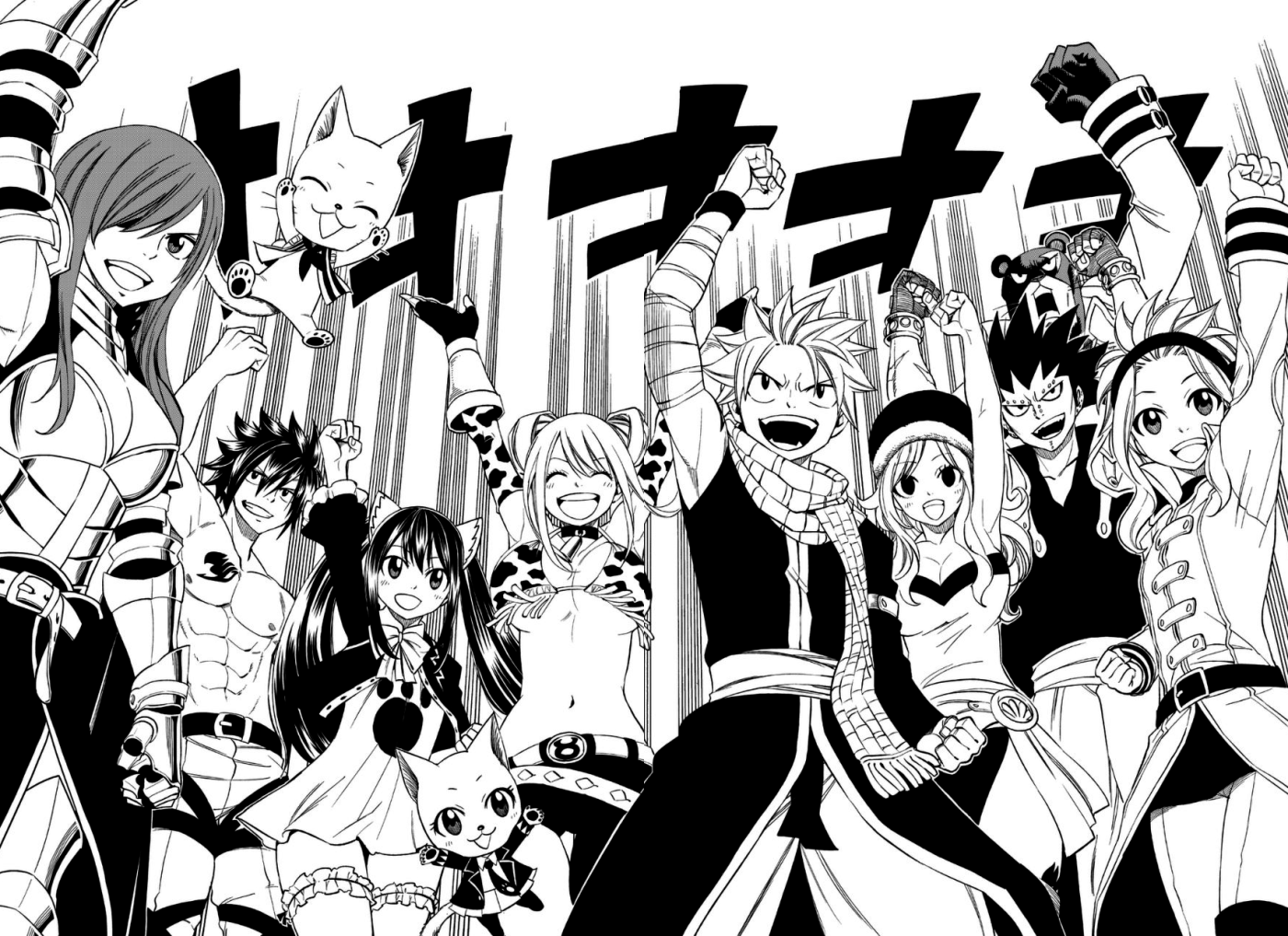
Now, having said all that, we’re talking about Fairy Tail because it’s a series I deeply love. Then what are its selling points, if there are rather big problems with it?
Let’s start with the big one. Fairy Tail as a guild is freaking dope. Joining a group of eccentric mages who are funny, social, very capable and will walk through hell and back to help out one of their own? Sign me up immediately! There’s a bond between these characters – which you also see in Mashima’s other works – that rivals even the bond of the Straw Hat Crew in One Piece. Where both Bleach and Naruto thrive on conflict within its main cast, Fairy Tail thrives when everyone’s eyes are looking in the same direction with no doubt in their mind that they will do everything for their friends. That’s also why the whole “power of friendship” thing can be a double edged sword. It’s not a very good way of writing an action story, but when push comes to shove, I still find myself very excited whenever an antagonist gets pummeled into next week. Add a fun but shallow world to this and a colorful – despite being black and white – magic system and you have a manga that may not win many prizes, but can be enjoyed without feeling too guilty. Out of the three manga I’ll be talking about, this is the one where I would recommend giving the anime a shot too. It doesn’t really add to the manga on my fronts, but the soundtrack is beyond incredible. The celtic influences are an incredible touch of genius.
Gantz
Oh dear, am I really going to talk about Gantz? Talk about a proper guilty pleasure manga. I almost considered leaving this one out for being a bit on the controversial side. It’s generally not a manga I would be quick to recommend to others. I considered putting Tokyo Ghoul in this spot but despite some of Sui Ishida’s stranger quirks, I think putting it in a post for guilty pleasures would be a disservice to the manga. So here we are, back to Gantz. Truth be told, I’ve read the Gantz manga back to front several times, despite its flaws. Gantz tells the story of two boys who both die in a train accident before finding themselves in a strange room. In this room is a black orb that tells them to fight for survival. They are given super suits and weapons – later on – and have to deal with an invading alien. If they succeed, they live to see another day and if they succeed enough times, they can escape this deathloop and return to life. Gantz mainly follows Kurono Kei and Masaru Kato, but has a large revolving cast of characters, some of which we spend quite a lot of time with. The harsh reality of the world of Gantz is that people die pretty often and pretty suddenly when encountering deadly aliens, and friendships often don’t develop long enough when all your friends are smears on the ground. Alongside the gratuitous violence is a pretty large amount of nudity and sex, which was definitely a part of the appeal when I was younger. As the story progresses we are introduced to more aliens, vampires and we even visit other alien civilizations. All the while things are going from bad to worse for many of the people involved until we finally reach a conclusion that leaves you wondering why you just spent all your time on this series.
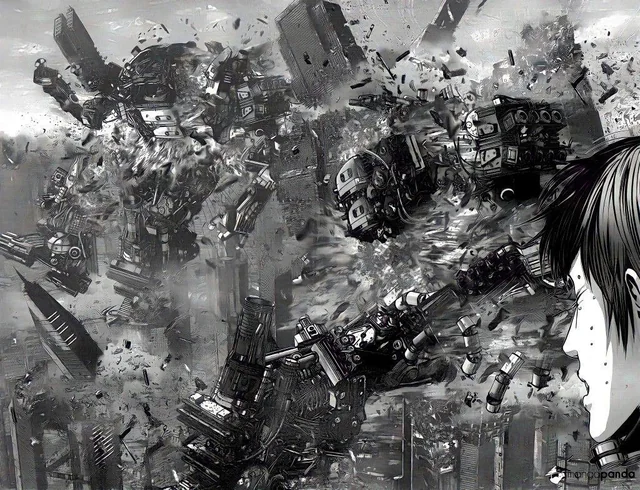
Now let’s address the elephant in the room. If violence and nudity were the only “problem” this series had, I would be recommending it a lot more often than I actually am. The truth is, in one of the later arcs of the story, a character decides that he wants to shoot up a mall. And when he does this, he does so in blackface. It’s a pretty awful arc and the implications that a black person shooting up a mall makes more sense than a Japanese person doing so is pretty sickening. The author also used computer generated images as the base for a fair amount of panels which makes for an interesting artstyle. I think it’s not a fantastic looking manga, but that’s the least of my criticisms. If you like stories that are unapologetically violent and can ignore some of the issues, then perhaps look into Gantz. There’s a CGI movie on Netflix that focuses on one of the better arcs in the series and I think it’s pretty well made, so that would probably be your best place to start.
History’s Strongest Disciple Kenichi
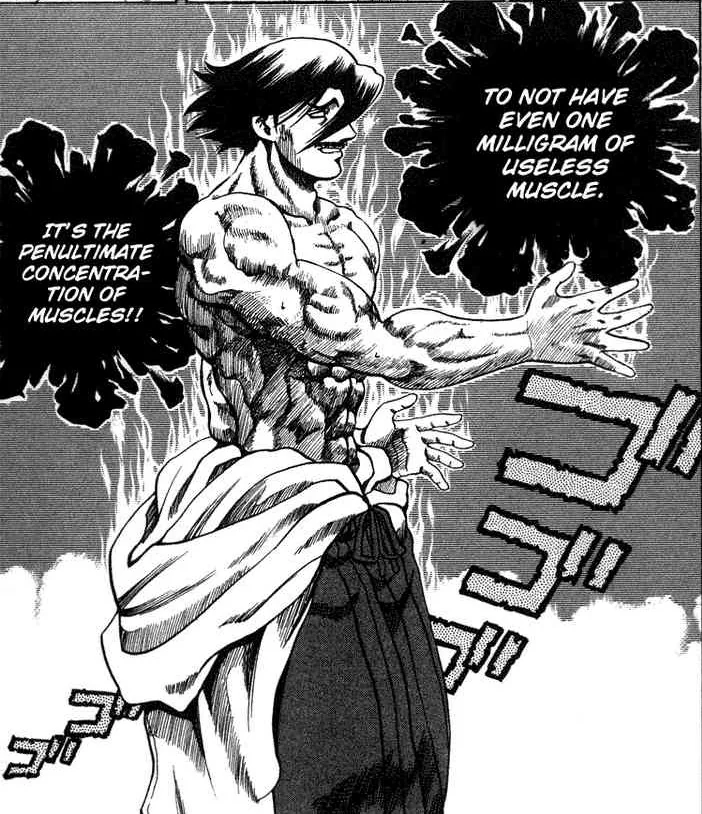
Let’s move on to a series that is a bit less controversial and a bit more palatable for the average reader. History’s Strongest Disciple Kenichi is your classic shonen action series. If series like Jujutsu Kaisen and Chainsaw Man get praise for breaking the mold and doing something refreshing to the genre, Kenichi is the most standard of series. The titular Kenichi is a young high school boy and a bit of a dweeb. He loves reading, has no friends, is weak and gets bullied. One day a transfer student comes to their school and kicks him in the face because he approaches her from behind and that is one of her bad habits. I know many girls who roundhouse kick their classmates in the face just for standing near them, so so far it’s a 100% on the accuracy. Kenichi and Mio – this girl – quickly become friends and when Kenichi gets into trouble with an upperclassman, Mio decides to help him prepare for the upcoming fight. Mio’s grandfather owns a martial arts dojo after all. The story follows Mio, Kenichi and their peers and mentors as they fight against all sorts of people with the stakes quickly increasing. From fighting a local gang to dealing with the members of Yami and Yomi, two dark organizations full of assassins, murderers and their apprentices. This story has your classic plot elements like villains who become allies as the story goes on, tragic backstories, increasing danger and of course lots and lots of borderline nudity. If there was ever a manga explicitly aimed at horny teenagers, this one takes the crown. Of course it has a bunch of shirtless men in peak condition, that’s normal for shonen action, but the outfits some of the girls wear are not very revealing. With some perverted characters among the cast, this is where the story derives a lot of its comedy from and although as a younger man this was part of the appeal to me, reading it back as an old man (I’m 33, so basically one foot in the grave) it gets a bit grating at times. I’m not one to shrink back from this sort of material by any means, but some manga do this just to appeal to their readers and it does nothing to improve the story.
Besides that, the story itself isn’t exactly mindblowing. There are a lot of very predictable “twists” throughout and some of the arcs can drag a little bit. Having said all that, I still go back to History’s Strongest Disciple Kenichi once every few years as a little treat.
There you have it. Three manga I would never consider to be pioneers in their field – perhaps Gantz has an argument with its interesting artstyle – but I still enjoyed enough to reread at least once. For Fairy Tail I would recommend the anime instead, although I also love the manga itself. In the case of both Gantz and Kenichi, they have short anime adaptations but I found both lacking and ending before things get anywhere all that interesting, so if either of those sound fun to you, definitely pick up the manga. I’m sure you can figure out some place to read it. Thanks for reading.
 Opal Kaharis