
When I first started watching anime – or at least started watching it while understanding that they were cartoons made in Japan – it was 2009. I was 17 years old. Because that time is when I got into anime properly, I’ve mainly watched shows that came out in the 2010s and the 2020s. I’ve woefully neglected a lot of older shows to the point where I get made fun of for how few Ghibli movies I’ve seen. This year I decided to combat that. I’ve already found myself watching less shows that are currently airing due to being a bit more picky so I have some time. I picked out some of the more highly rated anime from the 70s, 80s and 90s and I’ve started making my way through them. I began with a duo of Ghibli movies. I first watched Nausicaa of the Valley of the Wind and then after that I watched Laputa. Both were great by the way, I expected to be bored while watching them but they were far from boring. I think my experience with some other older shows – Urusei Yatsura comes to mind – has really dampened my expectations of old shows. So I was very pleasantly surprised when I started on the oldest entry on my list and ended up really enjoying it. So let’s take some time out of our busy days to talk about Rose of Versailles.

Our story – if you can believe this – takes place in the late 1700s. Oscar Francois de Jarjeyes was born to a noble who desperately wished to have a son. When Oscar was born a girl, he decided to raise her like a boy, turning her into a knight who would one day be the captain of the royal guard. Thus Oscar grew up as a boy, learning all the sorts of skills that a future knight would need. She grew up alongside André who worked for the family and was Oscar’s page for most of her life. At a young age she became the personal guard of Marie Antoinette, the princess who would one day become the queen of France and part of the downfall of the monarchy. Spoiler alert, this story does not have a happy ending. The two become close rather quickly as Antoinette is in pretty dire need of good company after leaving her home of Austria to come to a foreign land. The crown prince doesn’t seem to be all that interested in her and spends more time on his hobbies than his fiance. We then go through several stages of Oscar’s life which eventually culminate in the bloody French Revolution. If you want my spoiler-free opinion, then I recommend you give this show a watch. I did end up watching most of it at 1.25 speed. This show is very, very slow. It’s definitely noticeably old and although I didn’t find the art or animation an issue whatsoever, the speed at which every scene happened was definitely too slow for my taste. So give it a watch and if you’re on the fence after the first few episodes, I would say that the second half of the show is much, much better than the first half. This is reflected in the author’s intent as well as she moves from a more shojo-manga story to a much more political story with more focus on sexuality as well. Now then, with that out of the way, let’s charge head first into the Bastille, I mean spoiler territory.
The story can be divided into three parts roughly. The first arc is by far the least interesting in my opinion but it establishes the cast and their personality quite well. We get Oscar who is just starting out as the royal guard captain that is supposed to protect the future queen of France, Marie-Antoinette. Some attacks on her life happen and she gets into a feud with the king’s mistress, Madame Du Barry. Their feud establishes the childishness with which Marie-Antoinette interacts with others in the palace and shows that she is a force to be reckoned with. I don’t have much more to say about this arc if I’m honest, at this point in the anime I wasn’t convinced I would enjoy it that much.
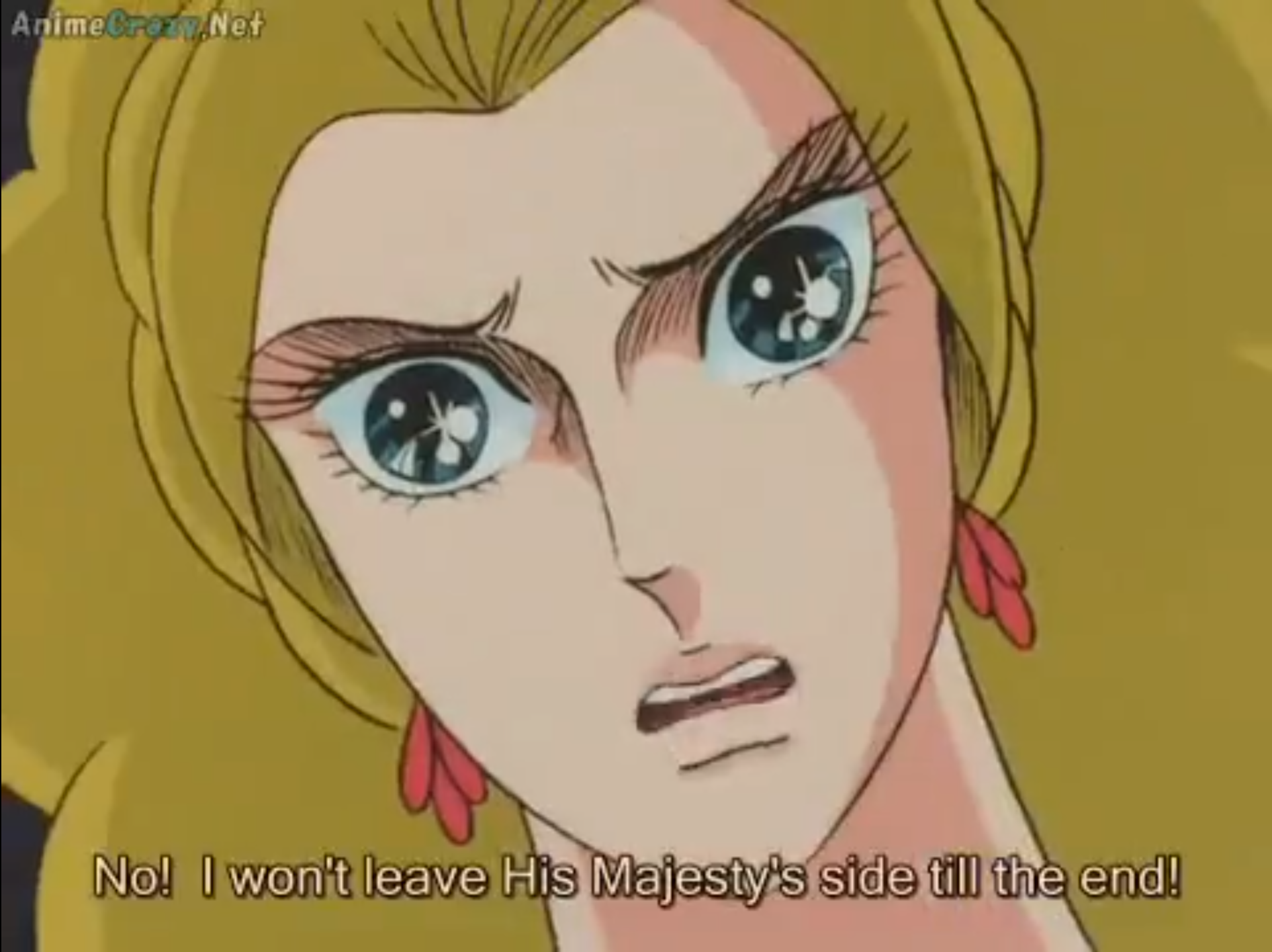
When we move on to the second big arc of the story we get into more interesting territory. This part of the anime covers the slow decline of Marie-Antoinette’s popularity among the regular folks which is in large part due to a single noblewoman. Madame Polignac is a noble with some financial troubles and once Marie-Antionette catches wind of this, she immediately bonds with the poor woman, helping her out financially and by increasing her status tremendously. Unfortunately, this quickly gets to her head and her greed gets the best of her. She starts to abuse her friendship with Marie-Antoinette to the point where the palace is spending an exorbitant amount of taxpayer money on the gambling wiles of the queen and her friend. While all of this is going on, a commoner named Jeane has managed to fool half the palace into thinking she is a noblewoman and is robbing everyone blind. This all culminates in the Affair of the Diamond Necklace which led the normal folk to believe that Marie-Antoinette bought a massively expensive necklace and had lesbian relationships with Jeanne. Eventually this all backfires tremendously for Jeanne, but the damage is done. One thing I want to take a moment to look at before we move on to the final – and best – part of this series is Madame Polignac’s daughter.
She has a young daughter named Charlotte who seems quite haughty but that’s likely due to her upbringing. As the plot moves on and Madame Polignac’s greed continues, she eventually plans to marry her daughter to a middle aged nobleman which absolutely terrifies the young Charlotte who is only 11 at this point in the show. After being assaulted by the man she loses it and ends up throwing herself off a tower, ending her life. If I had one criticism of this show, it’s how they handled this arc. I think they were quite progressive for their time, but I do feel like the aftermath of this horrifying moment was brushed over far too quickly. It happens at the end of one episode, and then the next episode focuses on a different storyline. But it’s also a show that’s almost 50 years old, making the manga even older, so let’s not be too harsh on it.

Finally, let’s talk about the French revolution. With Marie-Antoinette’s reputation slowly getting worse and Oscar struggling with her gender identity, the two split, with Oscar joining the French guard. André, who by now has lost sight in one of his eyes and is slowly losing sight in his other eye, decided to join her in the French guard company B, to Oscar’s dismay. The pair has to deal with a bunch of insubordinate commoners who are only in the army for the pay, which is very fair. Oscar struggles and manages to convince the people in her company to trust her by showing them what she’s made of. The pair both struggle with their health at this point in the story and as a viewer the writing is already on the wall. We meet Alain, who is one of the commoners that becomes close friends with André, and we even meet his sister, who ends up killing herself after her prospective husband abandons her. Through Alain and the other French guards we properly learn how bad things really are amongst the common folk, and Oscar gets a rude awakening. She still has love in her heart for Marie-Antoinette and the nobility which she belongs to, but she’s also losing faith in the way things are. Throughout this all, the revolution starts picking up steam and this all culminates when the États Généraux – which is the voice of the people that get to discuss politics with the nobility – gets excluded due to Marie-Antoinette telling her husband they shouldn’t give in. They change themselves into the National Assembly and refuse to give up. Despite Oscar giving the nobility advice to not ignore them, they still do, causing the army to be called in and a bloody fight to start. Oscar and her company desert from the army and join the revolution. She manages to get quite a few done, but as both André and Oscar get weaker and weaker, André gets shot and killed. Oscar follows him not long after. The two had finally admitted their love for each other, but they didn’t get a bright future together. Perhaps it was for the best as Oscar never had to see the downfall of her good friend Marie-Antionette. The epilogue shows Bernard, Alain and Rosalie looking back on the deaths of their friends.
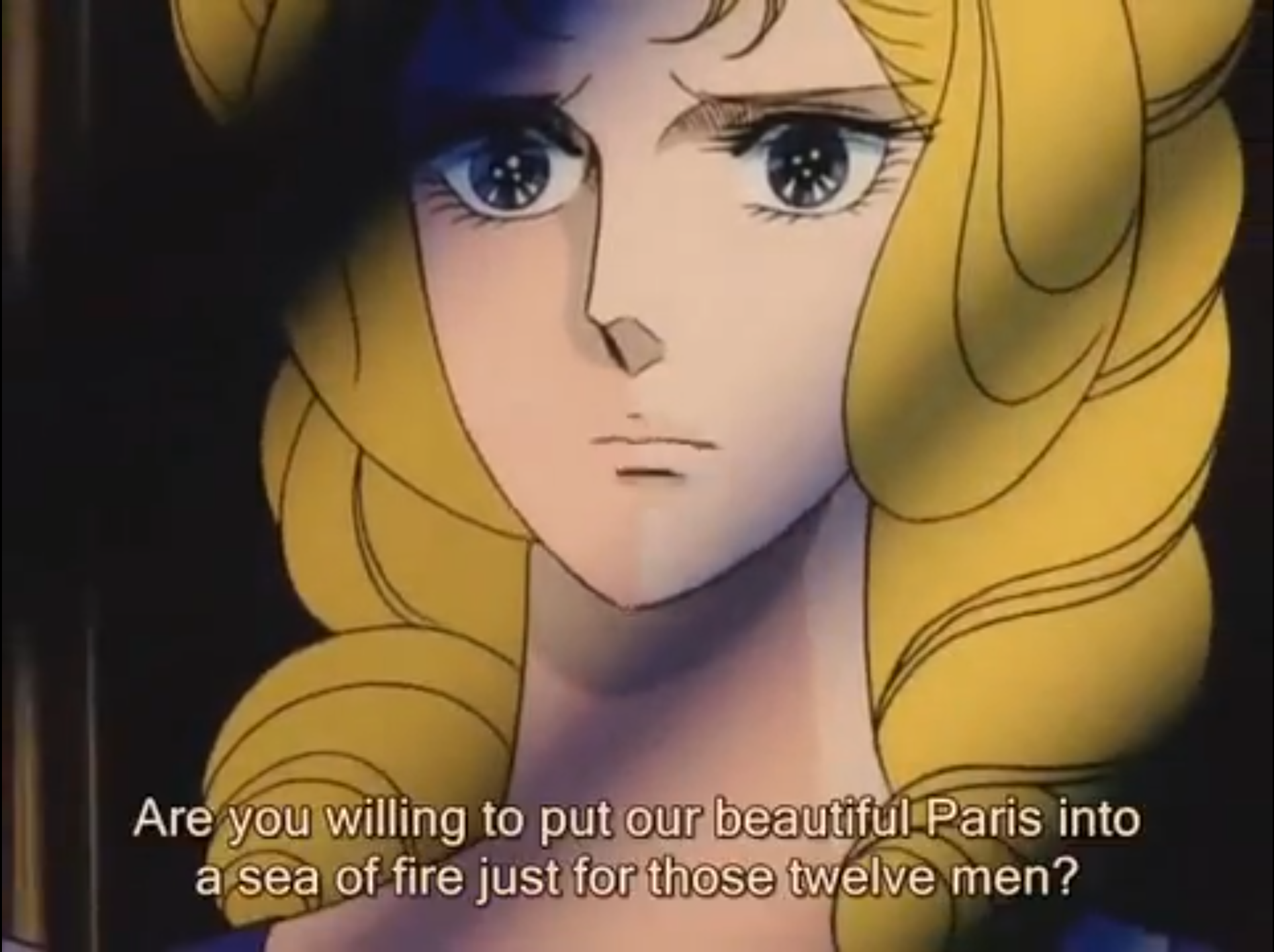
I’ve skipped quite a lot of content in this review for this is a story dense with interesting characters, plotlines and historical moments. Of course it’s also littered with inaccuracies, but it’s still a fictional story after all. What’s interesting to me is that the author was well known for having very left leaning opinions in a time when this wasn’t always appreciated. She was part of the communist party in Japan and a lot of her politics show in this story. Yet for someone who is very much on team “eat the rich” she also shows a lot of tenderness for the nobles in this story. Although there are some evil figures among them, they never get dehumanized and they go through sad moments that make us feel for them just as much as the good guys do. As someone who didn’t know a ton about the French revolution I ended up enjoying this show tremendously and I even learned a bit from it. I did have to check a lot of it to compare it to actual history as it wouldn’t do to take the show for facts, but the way the French monarchy fell is still fascinating to watch and knowing that some of the instigators – like Robespierre – didn’t escape the guillotine either makes it that much more fascinating. If you like drama and romance, this show comes highly recommended.

 Opal Kaharis