I’ve talked about this series a few times before, and it even made my top 10 anime of all time list, so I’m not going to write another essay about it. But with a new season of Ace of Diamond on the horizon, I wanted to quickly go over the show again and explain why I think it’s one of the better sports anime out there. It’s a personal favorite of mine although I can just as easily see someone preferring Kuroko no Basket, Haikyu or Run with the Wind. I really should rewatch some of those as well, they were all so good. But Ace of Diamond has a layer to it that I feel the other shows miss.
Get used to seeing his cheeky face, cause he’s in this show a lot.
And that is continuity. Ace of Diamond follows Sawamura Eijun, a prodigy in baseball in some aspects, but utterly average in most. He can’t field, he can’t hit a baseball and he can’t really behave responsibly. But he loves standing on the mound and he knows what it feels like to throw some really good balls, although he does not realize why his throws are as effective as they are. And on top of that, once his opponents figure him out, he’s pretty useless. Playing baseball with his middle school friends has been a lot of fun, but yielded no results. Luckily for Sawamura, a scout from the prestigious Seido was at one of his matches and he promptly gets invited to try out for their team. After some hesitation he joins the juggernaut of a school and quickly learns that he is not that special after all. Interesting, sure, but there are tons of great players there who want it just as badly as Sawamura does. Not to mention they have also scouted a monster pitcher in Furuya Satoru. This sets the stage for a season of growth.
Ball is love, Ball is life
As I’ve talked about before, one of the main draws of this series is how it takes its time with its cast. Players leave and join, more than a full year has even passed since the start of the anime and with over a hundred episodes there was more than enough time for the team to experience some serious losses, recover and come back stronger than ever. This allows for a fun show where the main team doesn’t always end up victorious. As much as I love some of the other sports shows, they are a bit predictable at times. Ace of Diamond has the luxury of a very long running series where all sorts of things are possible. At 47 volumes, there’s a lot of material, which explains why we’re getting another season in spring this year.
As is tradition with sports anime, this is Senpai’s last chance at nationals
Second, the story focuses not only on Seido itself, but spends a lot of time developing the other teams as well. I’m not saying that other shows don’t do this, as both Haikyu and Kuroko – as some of the more popular sports shows – spend time developing other teams. The main difference is that in some parts of Ace of Diamond, it’s almost easy to forget who the main team is as you start rooting for some of the other schools. And I don’t mean that as a bad thing, Seido is the most interesting team we visit, but some of the other schools have fantastic casts too and even the manager and coaches and the struggles that happen behind the scenes with replacements and other things add to the fun.
This show can get pretty intense at times.
To stop myself from ranting for another four paragraphs, I think I’ll mostly leave it at this. If you like sports anime, and are looking for a show that really keeps you occupied for a while, definitely check out Ace of Diamond. The cast is fun, the matches are great and always different due to different styles that teams can have and it got me interested in baseball as a sport. Then again, it doesn’t take much to convince me, I’m easily influenced. Thanks for reading!
I originally watched one episode of the Live Action for One Piece and wrote it off as something that simply wasn’t for me. With a second season coming out the other day, some of my friends convinced me to watch the new season with them, and in preparation I ended up binging the entire first season because I’ve always felt weird about not watching a series in full. Not that I don’t know the story of One Piece, but still. Afterwards I wrote a pretty negative review about the show that’s several pages long and mainly just consists of me talking about how much I dislike many aspects of the series. It does a great job with casting, wardrobe, environments and music, but that’s where the compliments end. I thought about what I could do to convey what I dislike about the series so much. It mainly boils down to the writing. A friend of mine said that this was written to be second monitor content and I think that’s accurate. The characters constantly spell everything out and they’ve removed much of the more subtle moments and character development from the original. Scrapping some content is fine to speed things up. I don’t mind them scrapping Django in Usopp’s arc or some of the running around and silly fights in Buggy’s arc. But Baratie was getting sloppy and by the time we reached Arlong Park I was getting angry. So let’s talk about that arc specifically.
Okay I lied, we’re still on Baratie. But only because it leads into Arlong Park. And although my knee-jerk reaction was to dislike the way they handled Krieg, upon reflection I actually don’t think it was all that bad. The only issue is that Live Action viewers don’t really have the same knowledge of Krieg’s power, so Arlong taking him out is not that impressive. I think Arlong showing up earlier and bypassing Krieg is a decent way to cut out some of the material. But it does cause a small problem here and that is the fact that Sanji gets his ass beaten in the arc he’s introduced, which is not exactly a good start to his character. But with Nami leaving for Arlong Park, the crew now needs to go to the island together, without splitting up like they did in the manga. There we had Johnny, Yosaku and Usopp go ahead, which turned into some very interesting scenes with Nami pretending to kill Usopp only for him to end up alive later on, proving that Nami isn’t truly a bad person. But let’s not get ahead of ourselves.
The crew arrives at Coco Village and meets Nojiko, Nami’s sister. Nojiko is angry at Nami for betraying the village to Arlong, and so are the villagers. This marks the first major difference with the manga that I disagree with. One of the most heartwrenching moments in the manga is when we find out that the people all knew what Nami was up to and were laying low to make sure she could try her hardest. It’s the anger they feel when Arlong betrays that hard work that drives them to finally attack Arlong Park. They’re stopped by Johnny and Yosaku who have already gone ahead and lost to Arlong and his crew. A minor nitpick, but Luffy bashes a hole in the wall in the manga while here they just enter through the door.
And man, what a place do they enter. I hate what they did to Arlong Park. This place looks more like a frat party than the gaudy imitation of Sabaody Park that it is supposed to be. The fishmen are all hanging out like a bunch of frat boys drinking and playing carnival games. It looks stupid beyond measure. I’m sorry, but I have to call this out for what it is, terrible. One thing that I think the live action does well normally is the set design, but they missed the mark so hard on this one. Due to the villagers not being involved in this fight at all, we miss the whole ordeal with Luffy being put at the bottom of the pool with his head above the water, but I think that’s probably fine on its own. What’s not fine is how the Fishmen are missing someone. By far the most important character in this arc – although we didn’t know it at the time – is Hachi. Hachi is the goofy octopus swordfighter who joined Arlong and his crew and then later realized the error in his ways. He redeems himself during the Sabaody Archipelago arc and this creates a wonderful circle that completes the pain and hurt that is caused to Nami during Arlong Park. Now I doubt the live action will get that far into the story, but the fact that they’re not even preparing for the possibility feels lazy and insulting to the viewer. Hachi’s shenanigans with Zoro were also one of two comedic highlights in this arc that have been completely removed just to shoehorn Buggy into the story. The second is Luffy picking up Arlong’s fallen out teeth and using them as a weapon to little to no success. Seriously, all the humor in this show is incredibly dumbed down. The silly things Luffy does in the manga that make this arc work so well are just not there. Luffy is a much more somber and serious character here, while his primary characteristic is how goofy he is.
But what does it matter that Hachi isn’t there? Well, it turns the fights into a much less balanced affair. Instead of a wounded Zoro fighting against Hachi and Sanji having to fight against Kurobe under water, we get the duo teaming up against Kurobe and still struggling. Not just that, Kurobe doesn’t even bring the fight into the water, which is why Oda wrote it so that Luffy was stuck underwater. Fishmen are far superior in the water and it was impressive that Sanji managed to hold his own against Kurobe while the two were submerged. All that tension is taken away here and just replaced by some simple choreography of Zoro and Sanji beating a single fishman on land. Elsewhere on the island, Usopp’s fight with Chu is also dumbed down and we do not get the incredible moment where Chu stirs at the end of the fight and Usopp just violently hits him with a hammer repeatedly until he doesn’t get up anymore.
What bothers me so much about this arc is that it’s not like it would be a horrendous arc in a vacuum. But when the source material is so well rounded, it feels weird that all of these decisions were made. Did they think people wouldn’t find the jokes funny? Or that they wouldn’t like the fights with Hachi and Kurobe? One Piece got this popular on its own merit, why did some Hollywood writers think they could do better? I could complain about this arc for hours and hours and fill several more pages, but I think I’m leaving it at this. In conclusion, they cut out all the humor in this arc and simply replaced it by Buggy being comic relief. They simplified the fights making them much less impressive and much less representative of the different characters and their personalities. They made the villagers of Coco Village much dumber than they were and in doing so removed a lot of the stakes that are revealed when they show understanding of Nami’s action as opposed to just being angry at her for betraying them. Nojiko’s wonderful care for her sister is replaced by hate and to top it all off, Garp and Koby show up to ruin the aftermath of the arc as well, which had several tender moments in the manga that are fully replaced by Garp being a complete and utter fucking moron. Seriously, how did they make him so wishywashy? It saddens me that many people are introduced to the story with such subpar writing included in it. Do better Netflix. Thanks for reading, I promise I’ll go back to being positive about something next week, but I had to get this out of my system.
As someone who was bullied for being different when I was a child, I have an understandable soft spot for stories about the subject of bullying. That doesn’t mean every bullying story will click with me, as it’s still a painful subject to this day. I look at some of the stranger kids I teach today and understand why I was disliked as a child when I see their behavior, knowing that they’re just trying their best to fit in. It’s a harsh mirror into my own past, but also a sign of growth. The person I was back then when I was bullied relentlessly is no longer the person I am today. And of course not just the person who got bullied changes. The person who did the bullying will change as well. How they will change, and in what way they will come to accept the aspects of their own life that they do not like looking back on, that is something for each individual to look at themselves. And the manga that inspired the 2016 movie does exactly that.
Now my bullying situation was not as bad, nor as black or white as what happened to Nishimiya Shoko. A young girl who cannot hear is transferred into the elementary school of our protagonist, Ishida Shoya. Shoya is a rambunctious child who highly values his ability to stave off boredom by doing crazy stunts like jumping off of bridges and into rivers. He is a popular kid with lots of friends by the time Nishimiya transfers. Nishimiya was being bullied in her previous school because she can’t hear properly, and is hoping to make a fresh start here at this new school, but things quickly go south. Shoya and some of the other children in the class see her as a threat to their fun life, due to them having to now tip toe around her disability. She participates in the choir while being completely tone deaf, she has to get someone else’s help to take notes and there is even the talk of learning sign language. What’s worse is that one of the teachers is even very opposed to being particularly accommodating for Nishimiya, even going against another teacher’s idea to learn sign language, causing even more of a rift in the class. It’s all heartbreaking to watch. Shoya destroys her hearing aids, her notebook, throws trash on her and even hurts her ear when ripping out a hearing aid, which we later in the story learn left a permanent scar.
When things eventually get so bad that Nishimiya has to transfer out once more, the atmosphere in the class has already shifted into a foul one and attention has gone towards Shoya. Unbeknownst to himself, he’s become so much of an unlikable character that his friends have now started bullying him as well. Nishimiya – who has been cleaning the graffiti off of Shoya’s table to protect him from the bullying – is now gone and Shoya becomes a total social outcast, which lasts until he’s in high school. Now 17 and severely depressed, he has one last thing he wants to do. He wants to apologize to Nishimiya before ending his life. So he searches her out and they talk. He even learned some sign language to be able to talk to her. After their conversation, Nishimiya tells him that she’ll see him next week and he decides not to end his life after all.
With this set-up, we get a world in which we can start exploring the lives and trauma of the children involved in the bullying situation. Naoka had a crush on Shoya and hated Nishimiya for ruining their friendship. Miki was the self-absorbed class president who has to come to terms with how unlikable she is and Miyoko has to learn to stand up for herself and stop running away from her problems. They’re joined by new friends, including Nishimiya’s younger sister and two classmates of Shoyo. Together they all try to make a movie, but they are hampered by fights, mental health and all sorts of issues along the way.
A silent voice has long been my favorite anime movie. In an era dominated by Your Name, I always found that this story about bullying touched me on a much more personal level. I read the entire manga in two days last week and couldn’t stop crying for most of the later volumes. Shoya is an absolute piece of shit as a child and seems to be beyond redemption yet through his actions in this story he does find redemption after all this time and it’s a beautiful journey full of pain, love, friendship, fighting and learning to be the best version of yourself. Anyone who likes emotional stories should absolutely watch this movie or read the manga. I would recommend watching the movie first and then diving into the manga afterwards. Do make sure you’re in a good headspace when you watch or read it though. There is some really heavy stuff in this series. Even putting aside some of the main themes, there is a surprising amount of depth hidden behind each one of the characters and although I think it had a very satisfying ending, it does leave you with some feelings that you’ll have to work through yourself. At least that’s how it was for me. Thanks for reading!
We open to the explanation of what this series is supposed to be all about. When a disaster looms, the goddess calls for six heroes to awaken and save the world. This happened six hundred years before the current story as well as three hundred years before the story. There are always exactly six of these braves. Then why are there seven heroes this time around? That can only mean one thing, there is a traitor among us. But first we need to establish the seven candidates who are claiming to be members of these six heroes.
Adlet as a character is definitely on the more abrasive side at times.
The first one is Adlet Mayer who proclaims himself the strongest man in the world and summarily interrupts a duel in front of the king. He does so by fighting dirty, but putting his methods aside, he is very effective. Then again, bringing a bunch of tricks and poison to what is supposed to be an honorable duel is a pretty shitty thing to do and Adlet soon ends up imprisoned. The second brave is the princess, Nachetanya, who is also known as the saint of blades. When both get chosen as braves, she frees Adlet from his prison and the duo set off towards their destination in the west. There they will meet up with the other four braves. Or five, as the surprise twist of the series ends up being.
Everyone’s favorite sad girl who has a deep secret and is just sad all of the time. Her character felt deep and well developed to me the first time I watched the show, but seeing it again now she seems much more shallow than back then.
The other five braves are an eclectic bunch too. The first two that we meet outside of the princess and Adlet are the princess’ personal knight Goldov as well as the presumed hero killer, the white haired sharpshooter Flamie. Where Goldov is ready to help the princess immediately, Flamie quickly proclaims herself an enemy and does not wish to join up with the rest of the gang. Separating from Nachetanya, Adlet now follows after the mysterious new girl. At the temple where they get stuck they meet the rest. Chamot, saint of the swamp, Maura saint of the mountains and finally a weirdo named Hans Humpty. It’s a colorful cast for sure, but this is the moment they all start to realize something’s wrong. That’s one too many. And all of them have the crest that makes them heroes. This is where the real story starts, a mystery to figure out who is the fake.
The gang’s all here, just imagine Hans off to the left, he’s just off screen after all.
So we have a locked room mystery. The moment Adlet encountered the fiend at the outskirts of the temple, he tried to break open the door, and when he did so, the barrier activated. No one was seen entering or exiting the room after he entered it, and we know that Adlet didn’t activate the barrier. We’ve seen him get his crest, we’ve followed along his journey and he is the only person we know for certain that is accounted for at the time of the betrayal. Knowing what the solution is to this puzzle – as I remembered it while I was rewatching it – makes it seem super obvious, but I remember being fully unable to figure it out the first time around. With all the pieces in play, we now have to deduce who the real betrayer is, deal with them, and then continue on the journey to actually deal with the fiends.
Oh, there’s Hans.
Upon rewatching this show, I found myself having mixed feelings about it. I like the concept a lot, but both Chamot and Goldov were getting on my nerves as characters pretty early on. There are some inconsistencies in the storytelling as well that feel more like red herrings than good writing, but these are minor complaints. Flamie and Adlet, the two we spend a majority of the time on, are both fun characters in all their bravado and teenage angst. It’s a real shame this never got a sequel, as it’s based on a light novel and we all know that most anime fans can’t read. I remember wanting to read the novels back in the day, and I still may one day, but it’s not high enough on my priority list right now to start on anytime soon. As for if you should watch it, yeah, probably. It’s a fun mystery with a colorful cast that doesn’t overstay its welcome. Although the twist at the very, very end kind of sucks and is the main thing people ended up remembering from the show. I do like reading light novels from time to time, and if you’re like me and every time you think back to this show you kind of want to see where it goes from here, at least the novels have been translated to English, although I did see that the physical editions are rather pricey. Ebooks are much cheaper if you’re one of those people, but I’ll leave it up to you. For now, if you like a good mystery, give Rokka no Yuusha a watch and if not, well, at least thanks for reading.
At the time of watching Orange for the first time, there were not very many drama romance shows I was familiar with. I didn’t really start my (shallow) dive into romance manga yet, and shonen action was definitely still my preferred genre (alongside Isekai). So a really solid drama like Orange – although not my genre per se – was always going to leave a big impression since the comparisons to other shows weren’t there yet. Which got me to wondering, how will I feel about this show if I rewatch it a decade later. By today, shojo romance manga are a staple in my manga consumption with series like The Fragrant Flower, Horimiya and Skip & Loafer all being favorites of mine. So with that all in mind, let’s take another look at Orange.
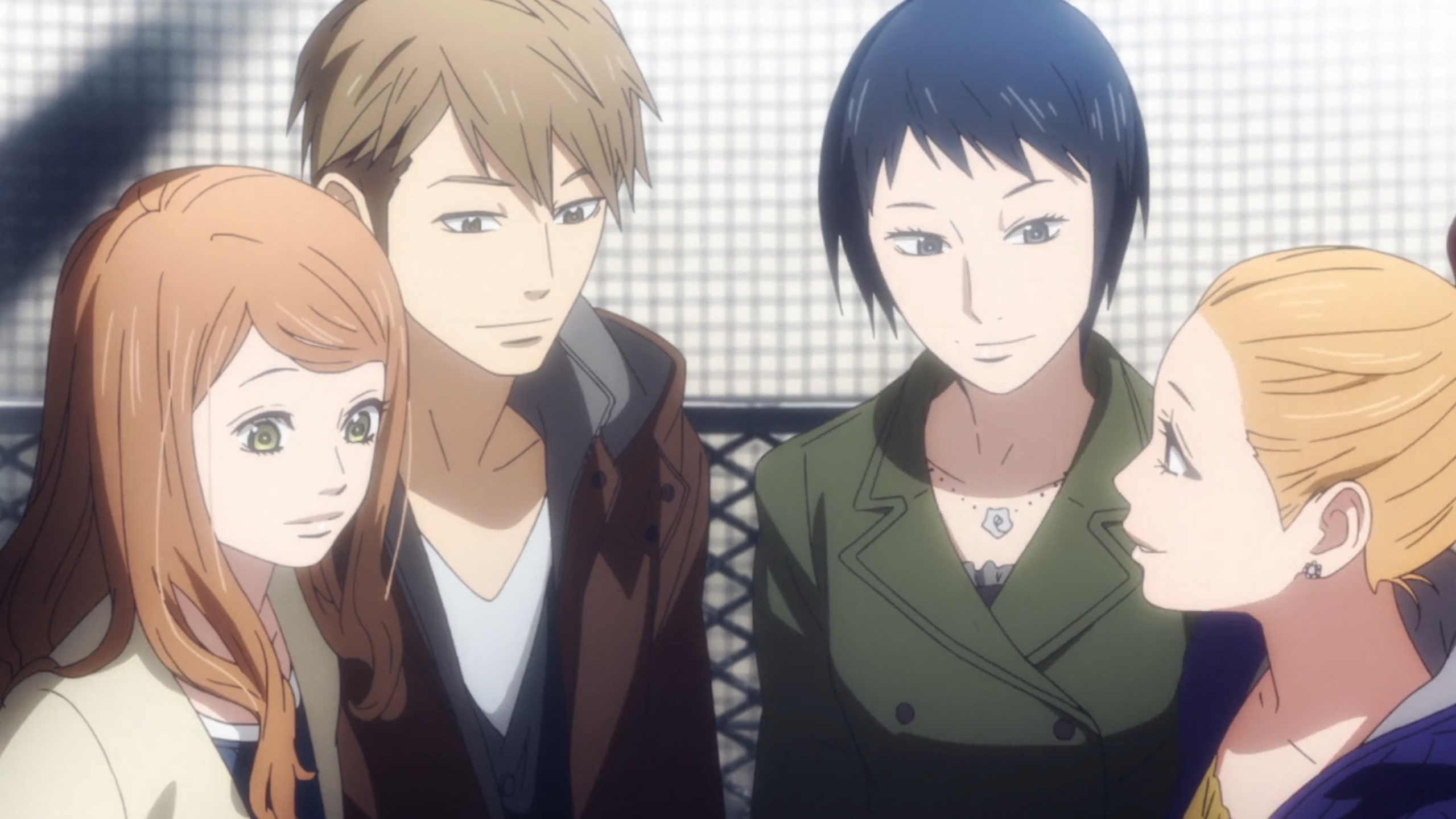
The cast comes together in the future to read the letters from their past selves.
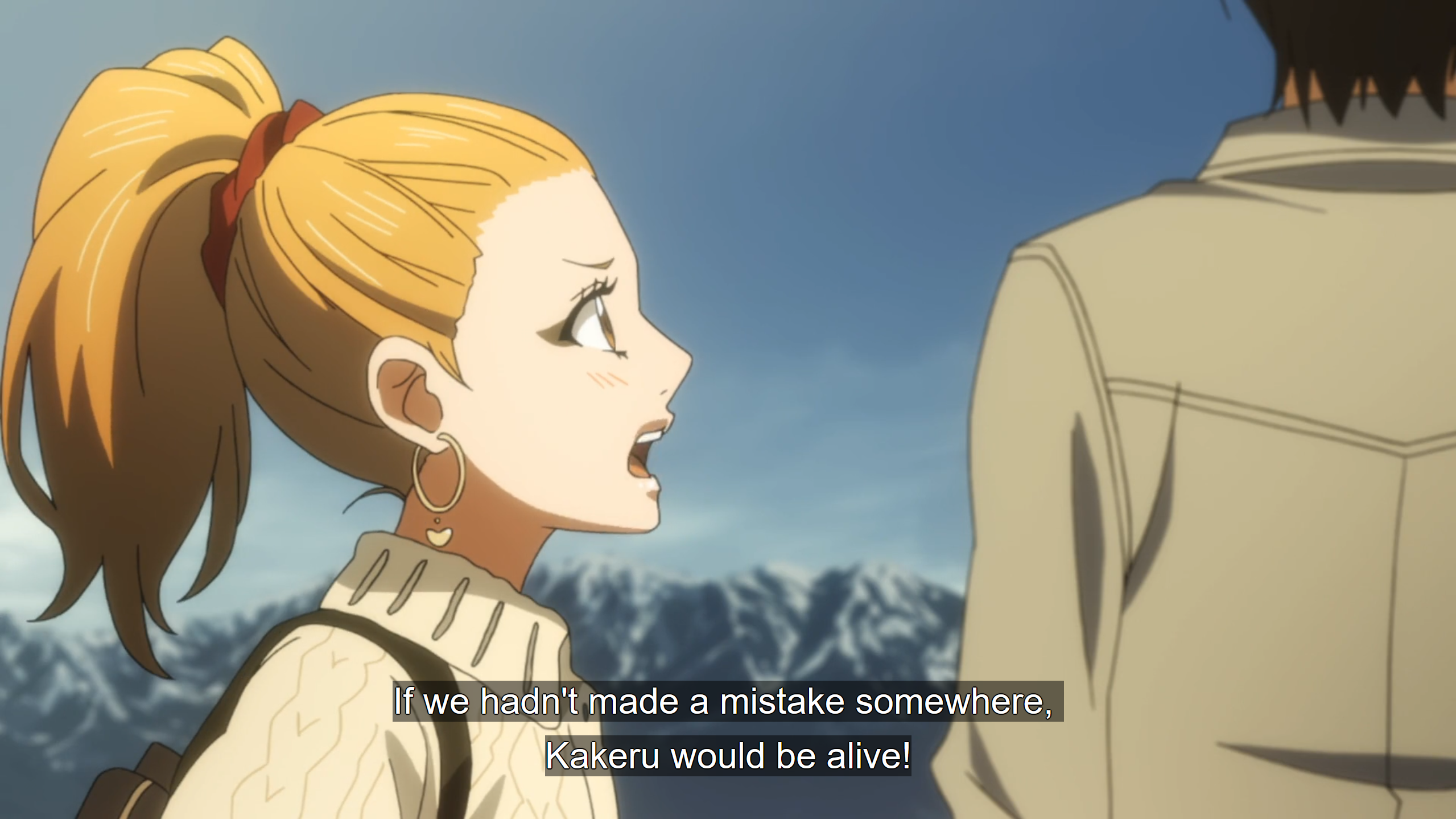
Let’s start with the two parts of this series that are the most memorable for me. The two things I could still remember after all these years. The first one is the core plot point, which involves the main character Naho sending a letter to herself from 10 years in the past. Apparently their friend Kakeru – who Naho has not met yet when she receives the letter from her future self – was going through a lot more pain than they realized at the time, and ended up dying tragically. Her future self then implores Naho to do things differently, in an attempt to save Kakeru. To prove that the letter is actually from herself in the future, she adds several diary entries about things that have yet to happen, and Naho watches as these events unfold in front of them, the first big one being the new transfer student; Kakeru.
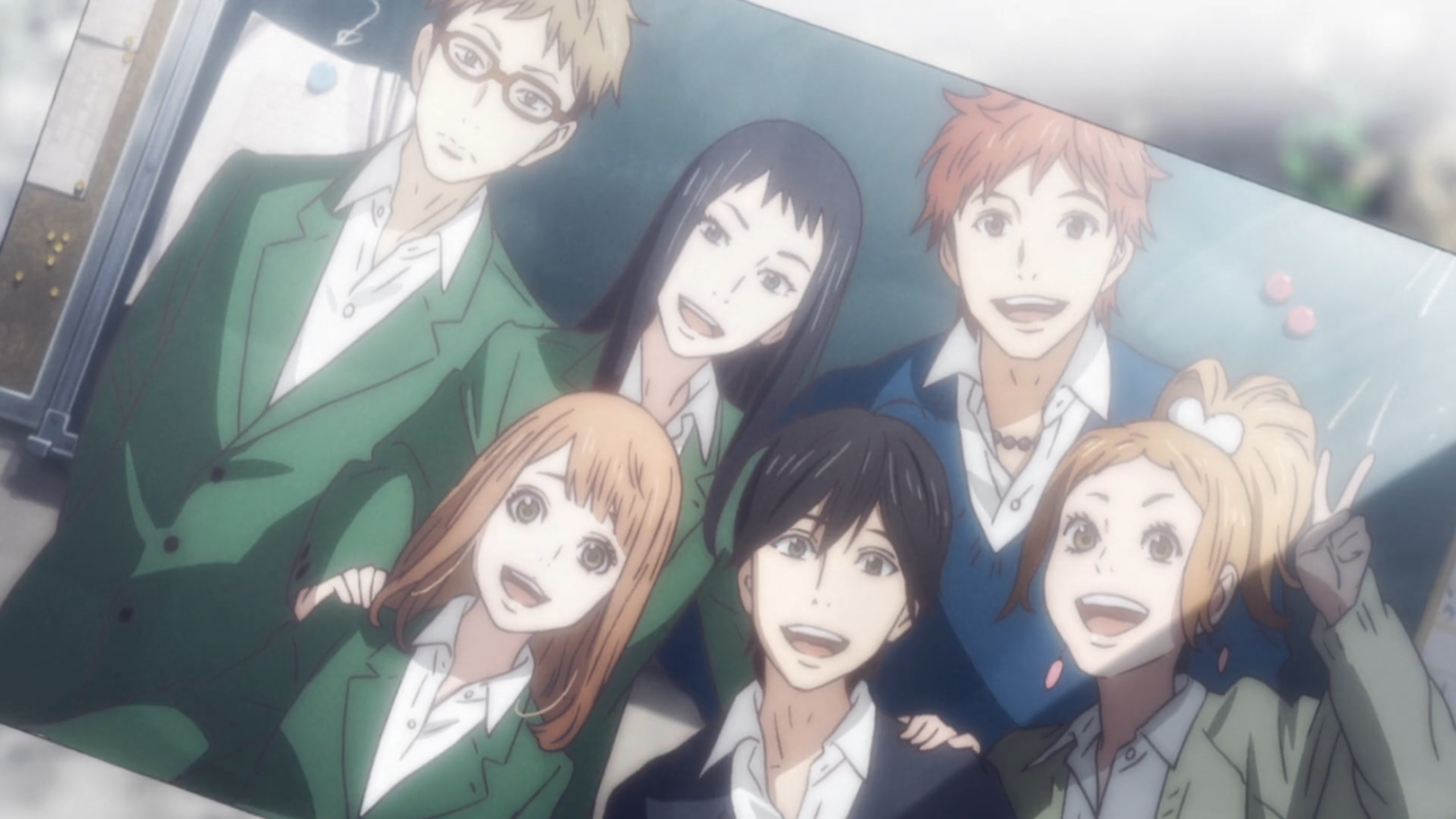
From top left to top right: Hagita, Takako, Suwa From bottom left to bottom right: Naho, Kakeru, Azu
The second thing that has always stayed with me about this show is the opening song: Hikari no Hahen by Takahashi Yuu. The tranquil and melancholic pop song has never quite managed to leave my consciousness completely, coming up in my playlists from time to time or while I’m watching anime opening compilations. It even sometimes randomly pops up in my head simply due to how incredibly catchy it is. The accompanying shots of the main cast are melancholic in a way that fits the music and it does its job of getting you in the mood for an emotional story.
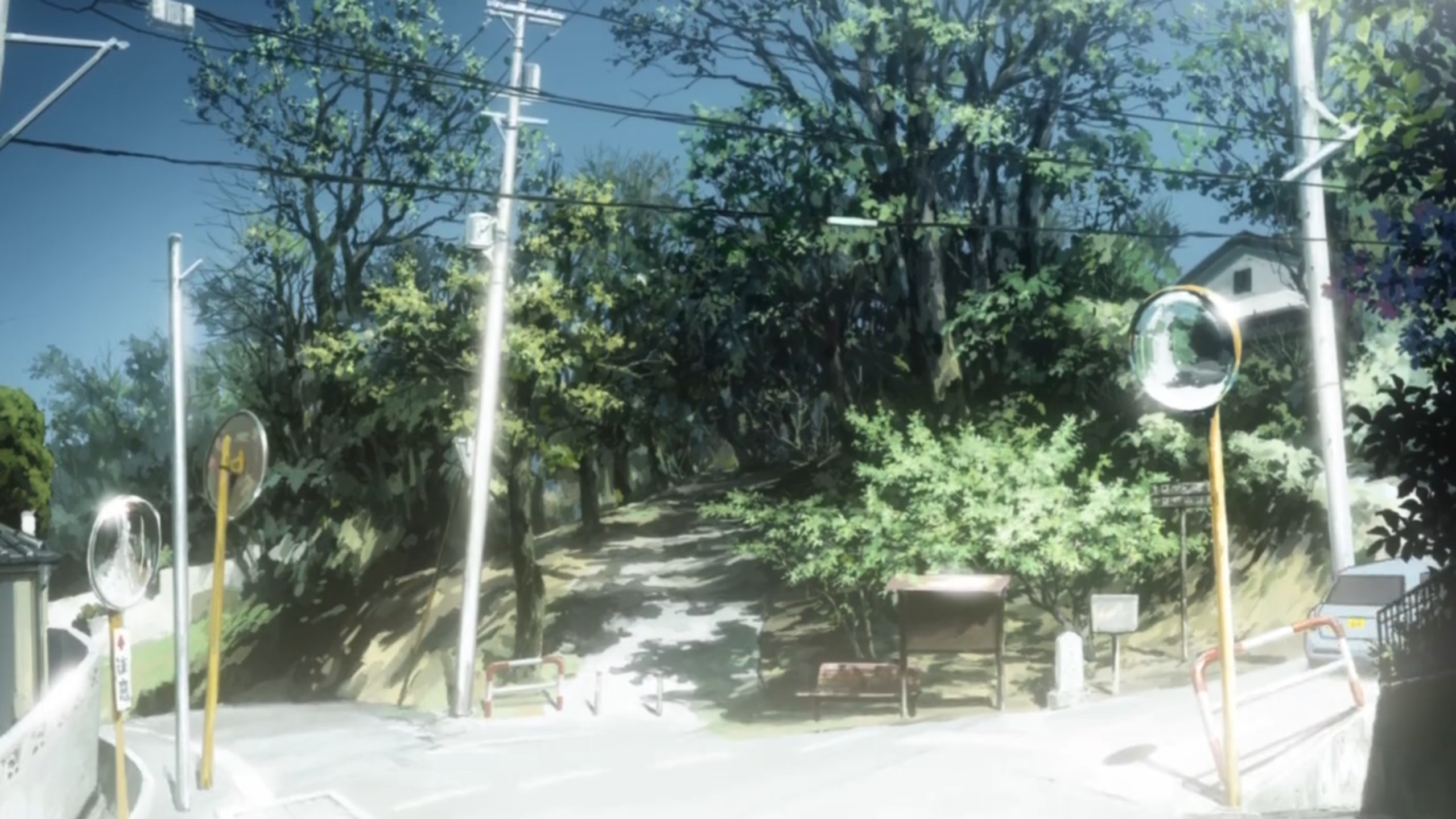
The first thing I noticed that I don’t think registered with me the first time I watched Orange is the backgrounds. This show does take place in a city, but it’s a more rural city than something like Tokyo – where Kakeru is from – and that’s very well conveyed by the backgrounds. Many of the gorgeously drawn shots have trees in them and the surroundings that the cast often finds themselves in feels much more open and tranquil than many other stories with similar settings. Skip & Loafer actually touches on this from a different angle, where we leave the city to visit the countryside later in the story and that really hammers home the difference in lifestyle. Orange is somewhere in the middle of the two.
This is what the town looks like a lot of the time, but also interspersed with more “modern” buildings and city streets, which brings for a very cool looking city that I’d love to walk around in.
Then the characters themselves. We look at this story through the eyes of Naho, but there is a group of six characters that we end up spending most of our time with. Naho is timid and kind, Suwa is popular and athletic, Azusa’s family owns a bakery and she is very outgoing as well. Meanwhile Hagita is much more introverted and spends as much of his time as possible reading, but he usually does so around his friends and joins them in any activities either way. Takako is more stoic and quiet. Lastly, we have Kakeru, the transfer student from Tokyo and the reason this story is happening. Kakeru is an interesting character due to how we learn some of his tragedies without seeing them clearly reflected in the character. Let’s dive into the story.
As mentioned earlier, the future versions of the friend group – minus Kakeru – met up long after the current timeline, and future Naho sends a letter to her past self detailing some mistakes she made due to being timid, that she would like her past self to avoid, in hopes of creating a better future for their friend. Although Naho is very sceptical – and still understandably timid – she quickly realizes that there’s definitely something to this letter, as it’s doing a great job at predicting the things that will happen in the next couple of days. After she fails to do anything different when Kakeru first shows up, the transfer student stays away from school for a while. We later learned that the reason Naho’s future version didn’t want her to invite Kakeru on their day out was because his mother committed suicide that afternoon, and that is why Kakeru was absent for a while.
Yeah, he’s a sad boy
Without going into spoilers, there is a lot of focus on being who you are and then changing that person to a different version of themselves that still includes some of their initial characteristics. In particular Naho is trying her best to become more outgoing and more confident. We slowly learn more as the series continues and later on there is a twist revealed to us that is pretty well foreshadowed, but I definitely didn’t catch it on my first watch through.
I’m not a big fan of time travel shenanigans usually and I mind it a bit less when it’s explained as separate worlds. The reality here is still true, but things are happening different in another timeline. Still, it’s a topic that I struggle to believe in.
Considering all of that, I think it’s safe to say that giving Orange a watch – if you haven’t yet – is definitely worth the time. It’s a well crafted melancholic romantic drama with well written characters and an interesting plot hook in the time travel shenanigans with the letter. It’s not going to reinvent the genre by any means, and it can be a bit slow at times, but I really enjoyed rewatching this series.
The first time I ever even really heard about Sailor Moon was through an Achievement Hunter video back in the day. Ray – who is now a Twitch streamer that I still watch after more than a decade – had a Tuxedo Mask skin in Minecraft and that was the first time I heard of the character and that it was from Sailor Moon. I sound so cool right now, don’t I?
Maybe not quite as suave and brooding as the real thing, but they got the rose right.
Years later, when I was well into my anime watching phase, about to recognize that it might not even be a phase at all, but more of a permanent illness, I knew very well what Sailor Moon was. A Shojo manga about magical girls and cats, and one of the most well known manga and anime out there, an inspiration for the modern generation. But I’d never actually watched an episode or read a chapter. For one, it was very old by the time I got into anime and although there are definitely older anime that I really love – Rose of Versailles comes to mind – I’m not quick to pick one up unless it really piques my interest. And second, I’m not a teenage girl, so I figured I wasn’t the target demographic.
Even before ever starting to read the manga, these were the characters I remember seeing, and I will say that seeing some of the other sailors throughout the series threw me for a loop. It’s also interesting how much I didn’t know. Like how Twitch streamer Ironmouse got her name from this series and how Amalee – whose musical covers I used to listen to and now sometimes pops up in streams I watch – voices one of the later sailors.
Having said all that, I am a pretty big fan of a lot of shojo romance manga. There’s something about how drama and character flaws are written in shojo manga that just feels much more real and tangible to me than a lot of shonen alternatives. Exceptions on both ends of course. So when I saw the announcement of the Naoko Takeuchi collection – a deluxe version of the entire manga at a lower price than the fancier box sets – I figured it was a good moment to jump in and give the story a shot. At the very least the box would look good on a shelf and the art prints would be a nice little thing to have. So I ordered both boxes, and then read through the entire story, extra volumes about Sailor V included. Let me give you my thoughts on the whole thing.
Let’s start with one of the biggest selling points for me, the art style. Obviously it’s a very recognizable art style, the classic old shojo drawings with the big eyes is one that will always be pleasant. There are some incredible artists out there who create panels that far outshine anything you’ll find in most weekly series. I for one really like Ishida Sui’s art in Tokyo Ghoul and Choujin X (although I couldn’t really get into the story of the latter) as well as SIU’s art in Tower of God. Another great one – and I will admit I had to look up the author for this one – Park Jin-Hwan from The Breaker. But there’s something just really nice about the classics too.
There’s also some fun attention to detail in this manga that really gives it a lot of personality. One thing that comes to mind is that when the main character – Usagi – is speaking off screen, her text bubbles contain a little image of a bunny, since that’s what her name means in Japanese. Usagi translates to bunny. There are also a couple of really funny moments in this manga that catch you off guard. A big one is that at the end of the first big arc, we start off the second arc with a toddler pulling a gun on the main character. If that’s not funny to you, I don’t think we can be friends. Of course that gets resolved pretty quickly, but it’s still a great moment.
This is what the Naoko Takeuchi boxes look like. This is not mine, I took this picture from Google. Contrary to popular belief, I don’t live in a white void.
Let’s talk about the characters next. The main sailors are great. Sailor Moon, Mars, Venus, Jupiter and Mercury all have their distinct personalities. You have the classic bubbly popular girl in Mina (Venus), the smart girl in Ami (Mercury), the stoic temple maiden Rei (Mars) and the transfer student Makoto (Jupiter). Of course Usagi herself is the titular Sailor Moon and she is your classic clumsy middle school girl who wants to marry her knight in shining armor – not an uncommon dream among the sailors – who ends up being the mysterious Tuxedo Mask (Mamoru Chiba/Mamo-chan/Prince Endymion). There are a lot of different names and titles for some of the characters. They each have their own history and future, and we later meet many more sailors in Pluto, Neptune, Uranus and Saturn. I’ll be honest, I wasn’t as invested in some of the later sailors. Pluto still seemed fun enough, but some of the subplot of these sailors having their own separate missions and being borderline hostile to the main group was grating at times. And of course in the final act we get a ton of different sailors from all around the universe which was fine for the story, but not particularly memorable.
The plot itself is a rather simple one. Some dark force is trying to kill all humans, drain their energy, take over the earth, the moon or both, destroy the future, whatever evil things you can think of. They start by sending some minions to deal with the sailors until they all get defeated and then the big bad is taken out. This repeats a couple of times until we’re at the center of the universe fighting the biggest bad out there. It’s not a particularly memorable plot, but it’s there mainly as a way to convey the moral of the story. And that is – of course – a coming of age story about young girls trying to find their way through puberty, boys and their dreams for the future. It’s a well executed story but the issue that plagues it in my opinion is a similar issue that plagues Bleach. I know, very different manga with a different demographic, but bear with me.
The first arc in Bleach is a group of teenagers dealing with an oppressive force of adults that is forcing their will upon them. The second arc in Bleach is a group of teenagers dealing with an oppressive force of adults that is forcing their will upon them. The first arc of Sailor moon is about a group of teenage girls who are trying to find themselves while dealing with boys, puberty and still trying to follow their dreams. The second arc of Sailor Moon is about a group of… you get the point I’m trying to make. Although the paint job is new each arc, it’s the same story just repeated a couple of times. By the time we get to the final arc, I was pretty bored of it. If this manga was half the size it was, I think I would be remembering it far more fondly.
Despite not being the target audience of this manga series, I really enjoyed taking a look at something that isn’t my normal cup of tea but is considered one of the greats. I doubt I’ll ever reread it, but I’m happy I gave it some time.
Lastly, let’s have a quick look at Sailor V as well. The prequel manga that follows Minako Aino before we ever find Sailor Moon. She is the titular Sailor V, the first of the sailor scouts to awake and a crimefighting teenage girl who wants to be an idol. With her cat Artemis – husband of Usagi’s cat Luna but we only learn about that later – she deals with all sorts of problems. We are introduced to Sailor V in the original story as well and she goes through the same trajectory there, but here we get a bit of a peek into Mina’s own life as a sailor scout before the group gets bigger. I didn’t enjoy the first of these two volumes. The second one was much better. There was more of an overarching story, the stakes were higher, and Mina was starting to come into her own as a character.
All in all, I’m glad I took the time to read this classic. It’s not going to ever be one of my favorites, as I’m clearly not the target audience, but I can see that a lot of love and talent went into creating this series, and at the very least the art is still really nice. I love the incredible animation in some of the more modern shows (and the latest arc of One Piece) but there is also something special about the charm that 80s/90s manga have. (and even older if we look at Rose of Versailles). If any of this piqued your interest, I recommend looking at the Naoko Takeuchi collection. It wasn’t too expensive (comparatively) and looks great on a shelf. Thanks for reading!
With a rather large school arc now seemingly behind us, we returned home to the cottage at the end of the last volume, where it’s time to wind down and relax a little bit, having dealt with Philomela’s grandmother and the accompanying corruption. Yet trouble stirs almost immediately again as the actions that Chise took by turning into a red dragon and swimming underneath the land have alerted the church and its allies, who are now investigating the incident to figure out who or what is responsible.
We start off this volume with Torrey giving Chise a bit of a history lesson about Britain and the witch hunts, which of course immediately triggers Chise’s visions and she almost ends up adding another curse to her long list of problems. Her being a Sleigh Beggy will never stop putting her into serious trouble whenever she is near anything even remotely magical, but she has good friends and allies here as Ruth jumps in to protect her. Back at Elias home we meet Jasper, the owner of said home and a long time patron of Elias due to a peculiar curse that runs through his family. His sister in law’s baby is currently the latest victim of the curse and they’re here to ask Elias to fix it. We learn about their history in a fun little side story and I wonder if we’ll return to this at some point with Chise putting a permanent stop to the curse. Oh right, and Zoe grows wings.
Josef and Elias meet at the information market where rumors spread. The aforementioned red dragon has been seen swimming under the British Isles and this is not a good sign, with a red dragon having the power to tear the earth apart into little pieces. Not many people and neighbours would appreciate that, but what they don’t know is that Chise is the one responsible. Josef ponders why he’s been left to stay here despite the horrible things he does and Elias basically informs him that he’s so unimportant that it doesn’t matter to him, which pisses Josef right off. Returning to the home, we learn that the first visitor of the year is underway.
The head of the St. George house is here with the official request for Elias and Chise to investigate the dragon, with Simon present to mediate for the church. Elias considers his options for a bit, which is a clear sign of growth for the mage. What’s even more important is that not only does he consider Chise’s safety, he also considers that of some of the other friends he’s made in recent memory, which is a completely new feeling to him. The duo confer and decide to help out with the investigation as long as nothing unsafe happens to Chise. That’s when we learn that Violet and Jasmine are also present, and Chise quickly figures out that there’s something odd about the twins.
This is where the different storylines start to slowly diverge into a common thread. Chise is likely undergoing a form of atavism. It’s a change in mythical creatures which was demonstrated by the dragon that went berserk as well as Zoe earlier in this volume suddenly growing wings. It’s a rare thing that can happen and it might be what is happening to Chise, allowing her to turn into a red dragon. Alongside all of this chaos, the St. George twins reveal that they have their own weird creature to deal with. It seems to be a newborn creature of unknown origin that has grown fond of the twins. They hid it from their father who found out within seconds, then they all hid it from Elias who also found out within seconds. They’re not very good at hiding things, but they think they are.
Lastly we zoom over to Lindell and the dragons, where a stranger approaches and danger lurks. Fortunately, it does seem like this stranger has no ill intent and is instead coming with a request. Hilda St. George asks him to come with her to England.
It seems like we’re still going to learn more about the different alchemist families, focusing on St. George now. They seem like good people and their house being responsible for dealing with all sorts of dangerous creatures probably means they’re pretty capable too. If only this doesn’t end in a tragedy for the twins or another curse for Chise. We can only hope. It looks like we will not have to wait nearly as long for the next volume, as the breaks around the last few volumes were quite long, but it looks like Volume 22 should be out in February or March. Look forward to another run through that volume when I get my hands on it and as always, thanks for reading!
Welcome to a new series I’m starting in 2026 in which we will revisit old series that I personally remember fondly to see if they hold up or not. This won’t be a weekly series, but there will be regular uploads. We’re starting with Rage of Bahamut: Genesis today.
2000 years after a disastrous battle with the ancient dragon of Bahamut – who was sealed by the angels and demons working together – the dragon stirs once again, and strange machinations are afoot. At the center of this conflict we find a quartet of characters who have to somehow navigate a war between angels and demons. Rage of Bahamut is based on a social card game by Cygames studio and is one of three anime to be made as a promotion for the game. Although the English version of the game shut down a decade ago, the Japanese version is still going and out of the many different anime based on games that I’ve seen, this one definitely stands out to me. Let’s talk about it.
As it has for years, this opening sequence has stayed in mind until today. It always gave me a Pirates of the Carribean kind of vibe and it’s stored in the same memory bank as Jack Sparrow running on the water wheel.
Favaro Leone and Kaisar Lidfard are two bounty hunters who are at odds. Kaisar blames Favaro for the death of his family and his fall from nobility and Favaro’s personality as a drunkard, pervert and general lowlife doesn’t help much with Kaisar’s perception of the red afro wearing bounty hunter. Bounties in this world are put on demons and collected in the form of cards, which only bounty hunters can collect and then hand off to Bacchus, the drunken god of wine and slacking off. Bacchus and his duck companion Hansa are returning characters in the series as well and develop a rather close bond with the main cast.
FAAAAAAVAAAAAAAAAROOOOOOOOOOO
One faithful day when Favaro spends the night boasting, he meets a young woman named Amira, who is trying to get to Helheim to see her mother. Favaro quickly proclaims he can bring her there for coin, with absolutely no intention to actually do so. Unfortunately for Favaro, Amira curses him in return, forcing him to accompany her on the harsh journey to this Helheim place. We soon learn that there is more to Amira than meets the eye, as she seems to possess demonic powers and perhaps even something more. She accompanies Favaro on the journey north, being chased by Kaisar.
Former nobility, reluctant bounty hunter Kaisar Lidfard, one of the four characters that make this show so much fun.
After dealing with Rita, a necromancer who lives in a city of zombies due to an old curse, but is sick of her lot in un-life, the quartet of main characters is complete although they’re definitely not all on the same page yet. Of course we learn more about Favaro and Kaisar’s complex history as the story continues, as well as what is the deal with Amira, but I will not get into spoilers for this.
Rita rounds off the main four and she’s a very fun character.
In the midst of this war between angels and demons for the keys to Bahamut, to either keep him sealed or release him and unleash mayhem on the world, there is a holy knight crowned by the archangels in the form of Jeanne D’arc. It wouldn’t be a fantasy story if there wasn’t a depiction of Jeanne D’arc after all. Hero of the people, chosen of the gods and hellbent on saving the world from certain destruction, she and her army are after Amira as she is a demon with one of the keys to Bahamut’s trap. Betrayal and death are around every corner as everyone on all sides of the conflict converges on Helheim for the finale of the story.
When I decided to pick this anime to rewatch, part of me wondered how well the quality would hold up. I remember enjoying the characters a lot – and even on a second watch the main quartet are an absolute joy to spend time with, Favaro most of all – and I remember it having a surprisingly high quality for a game adaptation. I think that quality definitely holds up after more than a decade. It doesn’t look like One Piece during the latest arc, sure, but the animation is serviceable and the darker than common art style fits really well for the dark themes and foggy and dangerous world we find ourselves in. The rest of the production also holds up, although it doesn’t stand out as amazing at any point, it never detracts from the show and I found myself quickly wanting to watch more of it. I’ll definitely cover the sequel anime at some point in the future as well.
This poor girl has not gotten much luck with her lot in life, but she has good friends at least.
So should you watch this show 12 years later even when you have no desire to play the game it’s based on? Yeah, I’d say so. I never played the game either, but I thoroughly enjoyed every second of the original run and my rewatch. Favaro, Rita and Kaisar are incredible characters with quite a lot of humor to them. I feel less strongly about Amira, but she is also more or less just a plot device given a voice. She’s not bad, but also the least memorable of the quartet. Supporting cast are fun, animations and art are solid, and the ending is satisfying. There isn’t really anything bad I can say about the show, so if you like fantasy stories with angels, demons and talking ducks, then definitely check out Rage of Bahamut: Genesis.
If you came here for another scathing review about the dumpster fire that is One Punch Man season 3, I’m afraid I’ll have to disappoint you. While I did watch it, I don’t think there’s anything I can say that hasn’t been said already. Instead I want to talk about another anime that involved punching, which I did enjoy very much: May I ask for one final thing?
Even Saitama is bored with being there.
A young Scarlet El Vandimion has been betrothed to the second prince of the Kingdom of Pallistan since childhood. But her prince turned out to be a real piece of work throughout his youth. That’s what you get for naming your son Kyle, I suppose. At a party for nobles he announces that he’s breaking the engagement with Scarlet, who has been silently bearing with his abuse. Now free from her shackles, she asks for one final thing. To punch both prince Kyle as well as his new girlfriend, Terenezza in their faces. She dons her punching gloves – which have studs on the knuckles because we don’t do things half-assed here – and punches the crap out of the many nobles in attendance as well as prince Kyle and Terenezza.
To the despair of her brother, this is far from the only nickname that Scarlet earns during this series.
This show really shines when it does exactly what it promises at the start. Scarlet punching the crap out of people who are written to be disliked is a very satisfying plot hook that is definitely a breath of fresh air. We have many villainess anime where someone is transported to another world to be the villainess, but to have the actual villainess beat up the person from another world for being a whiny person is a new one to me. Together with prince Julius (Kyle’s older brother) and the weredog Nanaka, this trio deals with all sorts of trouble throughout the kingdom as Terenezza is plotting to take over the entire place with her newly founded religion.
This poor guy can’t catch a break.
Where this show falls off a little bit for me is when we get into the second half and we start to actually develop a plotline about wars, alliances and different gods and powers. If I’m perfectly honest, the storylines surrounding that are rather boring, but the show manages to quickly regain your attention by having Scarlet ignore all protocol and just beat the crap out of whoever is in their path. Julius’ annoying provocations and the despair of Scarlet’s older brother about having to deal with his little sister add some nice light comedy to the show. With solid art, vibrant colors – especially when it comes to Scarlet’s design, who embodies the color that her name suggests – and decent animation, this show stands out above similar shows for me. If you like a show that doesn’t require you to do much thinking, but has some very satisfying moments, then I would highly recommend you check out May I ask for one final thing?. If only to get rid of the bad aftertaste that One Punch Man season 3 left. Thanks for reading.
Do not be fooled by his fake smile, this guy cannot be trusted.That is the correct response.
This review contains big spoilers for the original Bioshock game, basically revealing the core plotline. If you are just here to see if you should play it, then the answer is undoubtedly a resounding yes.
Would you kindly?
Powerful words. A polite way of asking someone to do something for you. On the surface it’s a completely innocent phrase, and on its own it is nothing more than that. But the writers of the 2007 game Bioshock use it to manipulate us and show us one of the most incredible stories that video gaming has been able to share with us. In my journey to make it through my gaming backlog I have included a couple of games I wanted to replay again since it has been many years, and the Bioshock series is part of this. Mainly because I never got the second game to work on my computer back in the day, so I only played the original Bioshock and then Infinite. Now I’m replaying the entire trilogy.
Bioshock takes place in the underwater city of Rapture. Built by an oligarch named Andrew Ryan, it is supposed to be a paradise away from the regular constraints of society. No pesky government to take your taxes from you, no pesky morality, no one bossing you around, just working hard and expressing yourself in the ways you want to express yourself. What could possibly go wrong? That’s where we come in. At the time we first make our way into Rapture, things have already gone horribly wrong. Most of the people living in the underwater city have fully lost their minds and the culprit is a substance named Adam. Without going full midichlorian on you, Adam is a substance that allows you to alter your body and give you superpowers. It rewrites your DNA and it is used to power up the protagonist in the games. The problem with Adam is that most get addicted to it and it makes the person unstable. This results in the addicts we fight throughout the game known as splicers. They were once humans who – due to using Adam on their body – have totally lost it. Then we also have the big daddies and little sisters, who go around harvesting the Adam from deceased splicers. Big daddies are guys in big suits that walk around protecting the little sister, a genetically modified little girl that can harvest Adam from corpses. In this crazy underwater world, we need to find a way back to safety and our only ally in all of this is a man by the name of Atlas.
Atlas tells us that his family is stuck and he’s trying to escape with them to the surface, and if we would so kindly assist him in his escape. We’re a good guy, so we obviously do and we soon come face to face with our first little sister, making the most important decision of the game. Do we harvest her or do we save her? We’re a good guy, so we obviously saved her. In neither of my playthroughs did I have the heart to go for the bad ending. We now get a little bit of Adam and the thanks of Tenenbaum, the person who seems to be responsible for these girls’ condition but is now trying to fix her ways. We continue our journey through Rapture and meet all sorts of strange people, most of whom are trying to kill us. Eventually we get to the escape pod for Atlas’ family but Andrew Ryan kills them. Now fueled by revenge, our goal is to go after the man himself, the capitalist anti-government creep named Andrew Ryan. After making our way through parts of Rapture, fixing up some systems and disabling some guard systems, we go into Ryan’s office and “kindly kill the son of a bitch.” It is here that Ryan reveals to us that we were a sleeper agent all along, working for Atlas – nay, Frank Fontaine – and being activated by the phrase would you kindly. On my first playthrough I did not expect this twist at all. Ryan manipulates this phrase to get us to kill him and we’re now at the mercy of Atlas who tells us to kill ourselves, but fails. It turns out that Frank Fontaine (Atlas), Tenenbaum and a scientist by the name of Dr. Suchong were the ones who created us and faked our personality while putting the activation phrases in our head. Tenenbaum feels remorse and removes some of the damage from us, while Suchong was killed by a big daddy during an experiment. Most of this lore we learn through audio logs that you can find throughout Rapture and it’s really nice that you can just hit play on those while you continue the game or choose to listen to them and wait. This is a feature more storygames need to add. Either way, we now have a new task. Deal with Frank Fontaine and save the little sisters.
The gameplay of Bioshock is mostly a lot of fun because of the resource management. You get money and ammunition from enemies as well as health and Eve hypos (mana). Yes, you need Eve to use more of your Adam powers. What makes it fun is that if you aren’t great at shooters – like me – you need to plan ahead, especially when fighting a big daddy. So put down some traps, make sure you have some grenades and anti-armor rounds and look for a spot where you can kite the enemies enough to have some cover. That last part feels like it is often a lost cause. The game isn’t so hard that it’s a problem, but I do remember struggling a lot more on my first playthrough. I didn’t play games as much as I do now, so I was really bad. Now it wasn’t that hard and the final boss fight felt very easy, but none of that detracted from my enjoyment at all.
What stands out in Bioshock to me isn’t so much the gameplay – which is solid considering it is a 20 year old game – but most of all the atmosphere. The combination of often somber and intense music with the dark environment, the beautiful ocean floor and the real feeling of Bioshock being a space that was once thriving – we get to see some of this in a DLC for Bioshock Infinite – makes this a truly haunting experience. I will never forget a scene early on in the game where we first get our shotgun. Right after picking it up from the corpse of a splicer, the lights turn off and we’re stuck with only a small spotlight. In the dark we can hear other splicers moving around and taunting us, before they attack us in waves. That scene genuinely freaked me out both times I played through it. The vending machines have some of the most memorable marketing tunes and add onto it a sometimes fun, sometimes very frustrating hacking minigame and you even managed to make shopping a tense experience.
There is much more to talk about when it comes to this game, which is impressive considering you can get through it in less than 10 hours if you rush things, but I recommend taking your time. I am not one who cares much for story in video games. I find that it’s often hard to tell a truly good story that can compete with movies or books in the setting of a video game, since the gameplay can sometimes take you out of it. But the way Bioshock feeds you information while you play, doesn’t force you to stand still and listen, but really lets you experience things at your own pace, while constantly keeping you occupied and tense really works wonders. Even if you did play this game when you were younger, I would recommend you play it again if it has been a while. Or let me rephrase that. Would you kindly (re)play the Bioshock series? Thanks for reading.