I consider myself to be an author. I write stories and I have been doing so since I was quite young, breaks aside. Whenever I read or consume other stories, I try to not only enjoy them for what they are, but I also like to look at what makes them work or what doesn’t make them work. Sometimes a story is great but part of it feels off and then I find it important to figure out what it is that makes it feel off. Other times a story does everything right and there really isn’t anything you can learn from it, you just marvel at its perfection. Frieren is one of those shows.
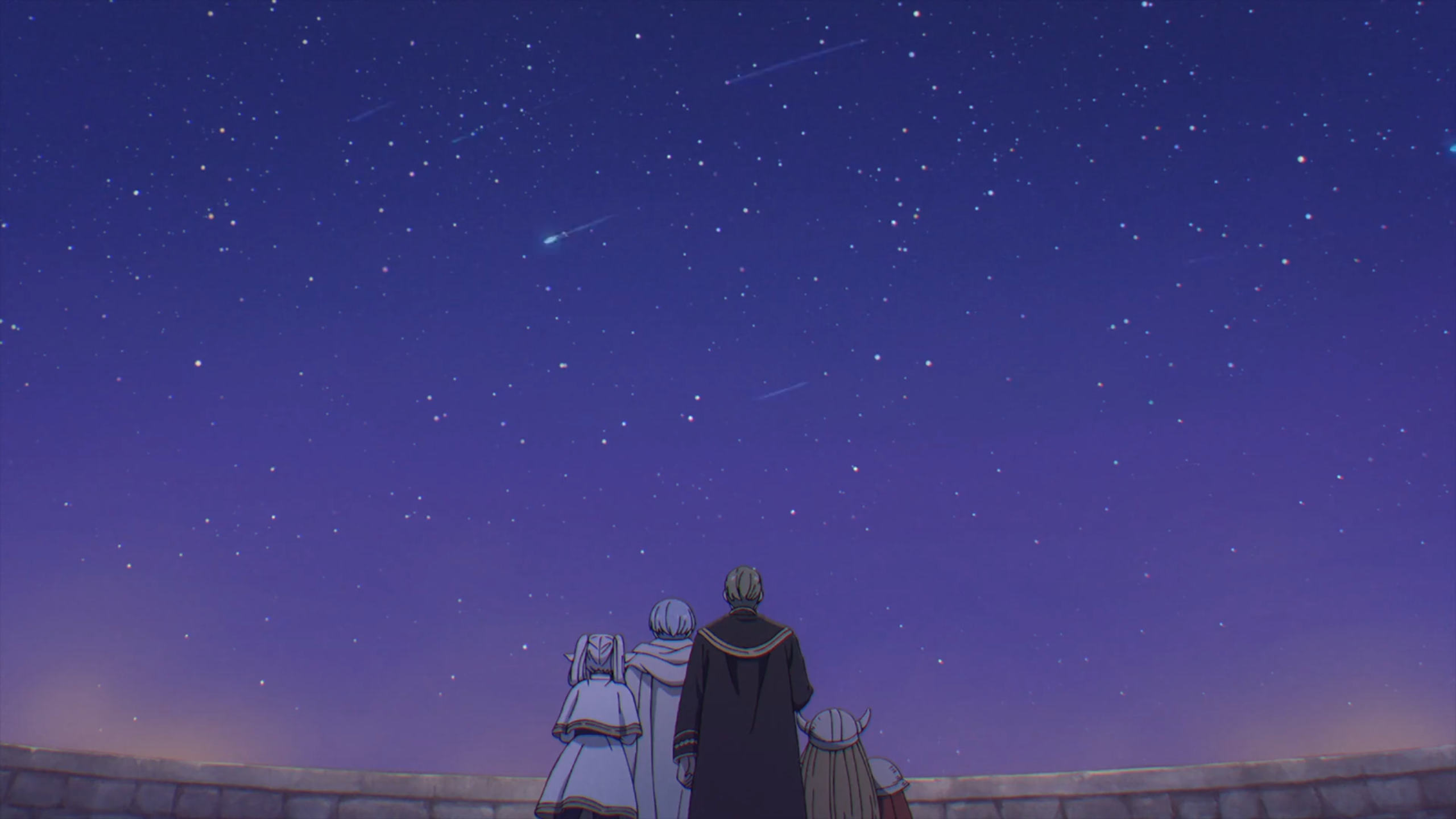
This beautiful sight is not that interesting to Frieren initially. She doesn’t understand a lot of things about the world yet, and the fleeting moments aren’t yet precious to her.
For the few of you that haven’t heard of this show yet, or don’t know much about it, let’s quickly summarize it. The hero Himmel and his party – to which the elven mage Frieren belonged – saved the world from the dangerous demon king and restored peace to the land. Fifty years passed and Frieren returned to meet up with her friends. Only upon meeting them does she realize how much the time that’s passed has changed them. Her friends are old and frail now while she’s barely aged. Even worse, that mere 10-year adventure that they once had together suddenly feels much more important than the blip on the radar she originally thought it was. We follow Frieren as she travels with Fern, a young human mage that trained under Heiter, the priest that was part of the hero’s party as well as Stark, a young man who trained under Eisen, the warrior of the hero’s party. Together, the three of them travel north for reasons I’ll not spoil.
I wouldn’t call Frieren an action anime, but when action happens it does so wonderfully.
What Frieren excels at is something that a lot of shows can struggle with. Frieren doesn’t move particularly fast at some points in time, yet there is a decent amount of action as well. This can often create that feeling of working towards the next big moment. So when you have a show that combines slower and faster arcs, it gets tricky to balance the slower arcs in such a way that viewers don’t get bored. Frieren never gets boring. I can watch the gang spend several minutes just doing chores in some town, help out an old lady with some minor inconvenience for half an episode or have an action packed showdown with a bunch of powerful demons. None of these moments feel better or worse than the other moments. Seriously. I don’t think I prefer the action heavy episodes over the slow episodes at all. And vice versa of course.
As I talk about, the quiet moments are what matters. The shrinkflation of desert, two teenagers slowly becoming more friendly while also working out their arguments. It’s all paced so incredibly well.
What makes this show so sad at times is how Frieren realizes through her current journey that her past journey meant so much more to her than she initially thought. Human lives are fleeting for a near immortal elf and the mere 10-year adventure felt like a blink and nothing more, but Himmel was such an incredible force of personality that more than 50 years later, after his passing, Frieren still feels his impact tremendously. With Fern and Stark at her side they travel north, slowly and leisurely. They help people, encounter problems and even take a dangerous exam, all the while Frieren reminisces on her similar journey with Himmel. It adds to this sentiment that there are signs of Himmel’s heroics everywhere. From statues of the hero himself to old folks who still remember him. There’s even new heroes sprouting to follow in his footsteps, motivated by his heroics. Even the priest and warrior are hailed as heroes despite Frieren knowing Heiter to be a drunk and corrupt priest, he’s a hero now due to his effort with the demon army.
Himmel the hero. Loved by everyone that knew him, gone but not forgotten.
Frieren is personal. Frieren isn’t a grand spectacle that feels epic in scale. Frieren feels like watching someone discover themselves through the love that others show them. It takes you along on Frieren’s journey of self exploration and she even manages to make some others reconsider themselves. Fern grows as a mage at a staggering rate and although Stark isn’t the bravest person out there, he has the right amount of courage when he needs it. We meet so many interesting characters along the road but the story also isn’t scared to leave them behind as we keep traveling onward.
The openings and endings are incredible. Both Yoasobi and Yorushika are some of the very best Jpop acts currently making music.
I can talk about this show for hours, as it’s easily some of the best writing I’ve ever consumed, but most of you have probably already seen the show and know this. I am mainly writing this post for the few of you who haven’t seen Frieren yet. Those of you who have can just nod along and agree that it was an incredible journey. It might have been a mere 28-episode journey, but it’ll still have an impact on our lives a long time from now. Thanks for reading.
This is definitely a first for me. I like finding new and different ways to challenge my students. Both in the forms I use for my lessons as well as the actual content. I know that some of my students like anime, but a vast majority most likely doesn’t interact with the medium at all. My second years (ages ranging from 13 to 15) have a listening and watching test coming up in a couple of weeks. We’ve been practicing for this test a little bit and they seem to be poorly motivated to interact with the practice material. It is pretty boring standardized stuff after all. Since we have some extra room in the curriculum, I wanted to take a lesson where we watch an episode of anime with the class and see how much they can understand. Of course, this would have to be dubbed, which I’m not used to, but dubs are no longer the neglected child they once were, many years ago. Now all I needed was to pick a show to watch.
I initially veered towards Frieren. Frieren is deep, thought provoking, hauntingly beautiful and witty. It’s also not the best and easiest entry into anime as a medium. It’s slow, it requires you to think quite a bit and the first episode – good as it is – doesn’t stand on its own as well as the anime I ended up picking. It still very much feels like I’m taking a plunge into the deep end but I believe the first episode of The Apothecary Diaries to have everything you need for a self-contained story. The premise is simple and the visuals of Maomao’s kidnapping are clear to everyone, even if you can’t follow along with the English. The story is self-contained and although there are some mature themes present in the first episode, none of it is inappropriate for teenagers. As a matter of fact, they are the target demographic for this show.
So now a little peek behind the curtain, how am I going to teach this anime to them as a lesson. Their actual test consists of two parts, the video part being a video with pauses to let the students answer a question. The questions are in order and there’s a pause – with an annoying beep – to mark where you are at in the test. I’m only going to pause every few exercises so as to keep it from getting too interruptive. I’ll tell them ahead of time how many exercises I expect them to answer before the first pause. Speaking of the exercises, a majority of them will be multiple choice. That’s what they get in the test itself too, so it only makes sense to practice appropriately. I’ll include the actual assignment below for if you happen to be an ESL teacher teaching listening skills to this particular age range. But depending on the reflection part of this post – which is coming up next and which I’ll write after teaching – this might be a scrapped lesson. If it was a disaster, you won’t even see this post at all, but if it just wasn’t very successful I’ll let you hear about it at least.
So, now that the lessons are all done, let’s talk about how it went. I put a questionnaire about what they thought about the assignment on the back and had them hand it in. That is the easiest way to get information after all. Right off the bat, two things stand out to me. The first class was not very motivated to do listening practice and this was reflected in their lack of attention during the video. Half the kids were distracted by other things and only a few students seemed to really care what was going on. From those students, a few did say they liked it, but most of the kids didn’t care for it much at all. I didn’t ask if they would prefer this over the coursebook’s own material, perhaps I should have clarified that. It could very well be that they prefer that material, or that they just don’t like listening practice at all. I do reckon part of it was definitely that they didn’t like the video all that much.
Hello, it’s future Nick here. I’m writing the rest of this post after I’ve finished teaching it to all three of my classes and read through their feedback. It gives me a pretty consistent insight. There are a few students in total who really seemed to like it, some even saying they loved it. That’s good, I didn’t bore every single one of my students to death. Having said that, I don’t think this lesson idea was a success. A vast majority of students didn’t like the video at all and although they don’t like listening practice in general, if it’s something like this, which is different from the standard they learn, it needs to really add something. I don’t think that’s the case here, so it’ll be a one and done for me. I did have one student comment that it would have gone better if we watched the first episode of Jujutsu Kaisen in class, but somehow I don’t think he’s quite right. Anyway, I’m going to go back to the drawing board. Unfortunately for the time being I’ll just use the provided material from the school which is incredibly boring for everyone involved, but requires much less prep time than this. I’ll still include the exercise itself down below for those curious, as well as the feedback form I had my students fill in after the assignment. Tomorrow I’ll have them fill in the blanks in Counting Crow’s (and originally Joni Mitchell) fantastic Big Yellow Taxi. That’ll go over better I think. Thanks for reading!
Maomao’s father tells her to be careful, why is that?
There are wild bears in the area.
People are being kidnapped lately.
The weather is going to be dangerous
What does the visitor call Pairin?
One of the three princesses of the Verdigris House
One of the three angels of the the Verdigris House
One of the three beauties of the Verdigris House
Which people are allowed in the rear palace?
Everyone who works for the emperor
Women, loyal men and the emperor himself
The emperor himself, women and eunuchs
What is a eunuch?
Why are there rumors of a curse in the rear palace?
People are disappearing mysteriously.
The emperor’s heirs are dying.
Someone saw a ghost.
After figuring out what is happening, Maomao needs something to write with, why?
To write a letter to her father about the illness.
To write in her diary.
To write to the two concubines to tell them why their children are ill.
The man who summons the serving girls is called Jinshi. What is his job?
Emperor
Manager
Detective
What skill does Maomao have that Jinshi uses to trick her?
What ended up being the reason that the babies got ill?
The white face powder the concubines were using.
The food they were given.
The poisonous flowers that were in their bedrooms
Who does Maomao become a lady-in-waiting for?
The emperor
Concubine Lihua
Concubine Gyokuyo
Name: Class:
What did you think about the video?
I loved it
I liked it
I thought it was alright
I didn’t like it all that much
I disliked it
How difficult was this video?
Easy
Not very difficult
A bit difficult at times
Quite difficult
I didn’t understand much of it
Do you want more listening practice for the upcoming test?
Firefighter Daigo is an anime that is adapting a manga that is a sequel to a 90s manga. It’s about a trio of young firefighters and their training, first missions as well as some of the drama surrounding all of them. It’s an alright show. The concept is good and when it’s “on” it’s doing pretty damn well, but it has a glaring problem that runs through the entire show. Few episodes suffered as much as this latest episode where – according to a reddit user – there was 62.5% of reused footage. Including the opening, ending, eyecatches and the recaps and flashbacks to previous episodes there was almost 15 minutes of reused footage, leaving about 9 minutes of actual new content. This combined with two recap episodes so far really puts into question the decision to make this anime run for two cours instead of just keeping it at 13 episodes. But let’s put the pacing issues aside for a moment and let’s talk about something that this anime does really well. And to do this, I’m going to have to go into spoilers, so as usual, this is your warning. If you’re just here to see if this anime is worth your time… probably not. It’s good at times, but it drags too much and unless you skip entire chunks you’re going to be very bored. Now then, that out of the way, let’s talk about vulnerability.
At least he’s got more guts than most anime characters, Shun’s honest about his feelings and it’s one of his good qualities
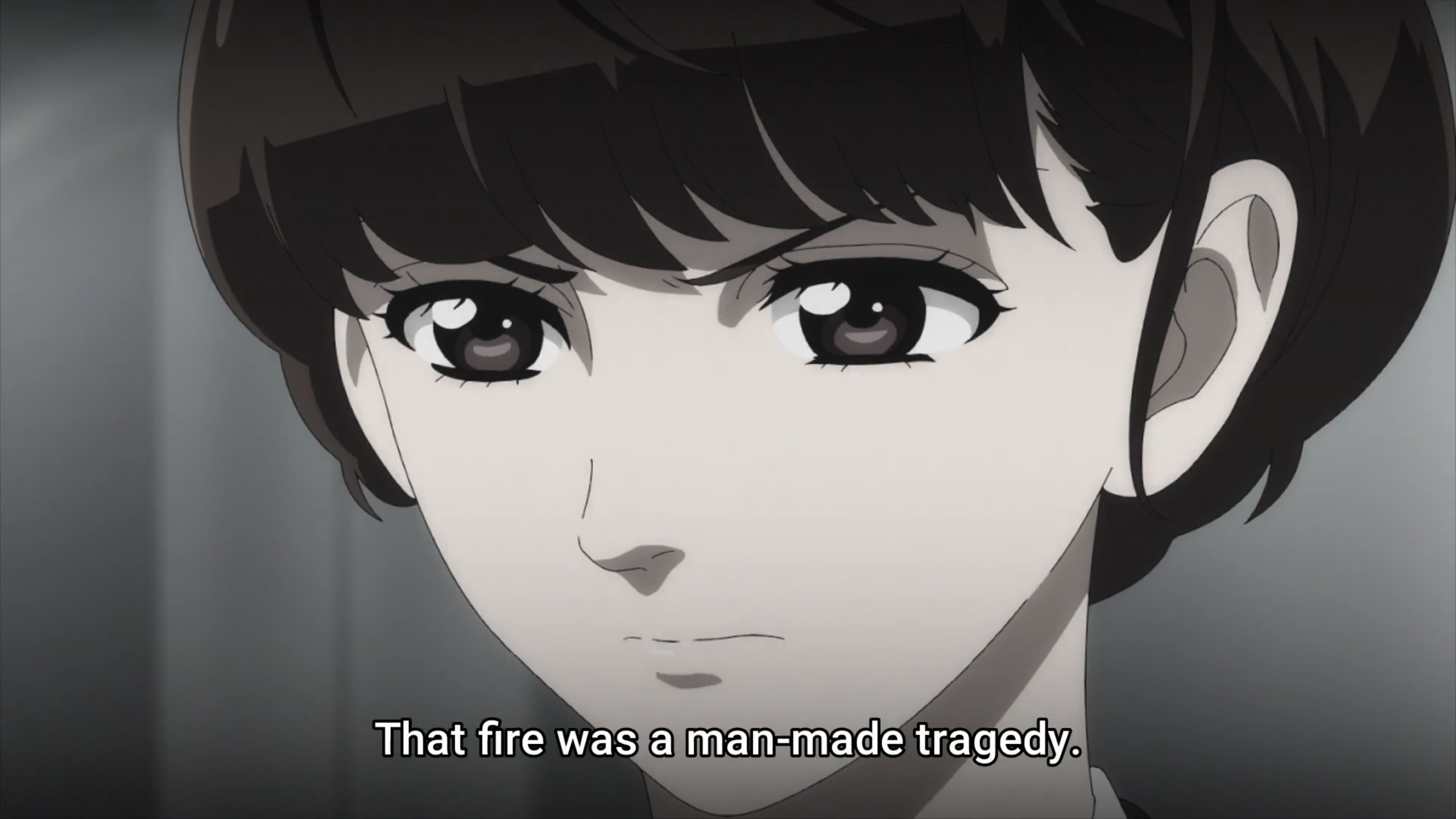
Yuki and Shun both went to the same high school. Shun has had a crush on Yuki for a while and when he saw that she had a firefighter as her phone background he decided to ask her out, promising he’d become a firefighter. Yuki herself also started the path to become a firefighter and during their training the trio is completed with Daigo. Unbeknownst to Daigo and Yuki, they also have a bit of history together. It turns out that Yuki was a survivor of a tragic fire. Her family died and the CEO of the hotel that burned down was responsible for the fire happening. Yuki – understandably – harbors a ton of resentment for the deceased CEO of this former hotel. What she doesn’t know is that Daigo is actually the son of this CEO. Now, obviously crimes aren’t magically inherited and if I were to wager a guess as to Yuki’s reaction to eventually learning about this I think she’ll probably agree with me. But that’s not what I’m here to talk about.
Yuki is probably right, many accidents happen due to budget cuts and laziness.
Instead, I want to take a look at the third character in our trio: Shun. Shun initially only wanted to become a firefighter to impress Yuki, but he quickly became fully invested in the dangerous but rewarding job. He’s a hard worker but he can also be a bit dumb at times. On top of all of this, he is a bit selfish, doesn’t have the best self-esteem and can be awkward. But what he lacks in any of those fields he makes up for in compassion and emotional vulnerability. In an age where algorithms like to spoon feed toxic masculinity into our feeds, teaching us that you need to be the big man who is strong and never wavers, women should bow down to you and if you’re not working out you’re wasting your time he shows a different angle. In episode 19, Shun learns that Daigo’s father was responsible for the deaths of all those people in the hotel and it hits him like a ton of bricks. He weeps for his friend, understanding how hard this must be. He also cooks him a meal to cheer him up and cries once more, realizing how deep Daigo is stuck in his trauma.
He’s not whiny, he’s not crying over something silly, he’s just compassionate for his friends and realizes his own flaws in the moment, growing by learning.
Shun is a firefighter. He can lift heavy things, climb buildings on a rope and do some incredible feats of athleticism. He’s literally someone whose job it is to save lives. He is about as manly as you can possibly get. I think the fact that he’s a good example of a strong man and he is also emotionally vulnerable when his friend is hurting is such a great character trait. Obviously it should be relatively normal to be there for your friends, but people like Shun are rare in modern media. Maybe I’m self reporting here that I’m watching the wrong shows, but I feel like someone like Shun doesn’t exist in most shows. He’s a breath of fresh air and if this show was a little bit better I think it would have been an easy recommendation. Unfortunately it lacks a lot in other departments and combined with the pacing issue it makes for a mediocre anime. But I do think that if you have a bit of time you don’t know what to do with, you should give this show a shot. Skip the long recaps and cut off all the extra fat and hidden below it is a solid show about firefighters. Thanks for reading.
I’ve been a fan of Yorushika’s music for several years now. A friend introduced me to their music before they became more popular and I fell in love immediately. This isn’t my first time talking about their music here, but I haven’t spent much time lingering on it. They’ve not done a lot of anime openings – as far as I know – but they did do one for Kaina last year and then another one for Frieren that is currently airing. Following up Yoasobi for that show was a big ask, but I think they nailed it. But those songs aren’t the only good songs they’ve made, as a matter of fact, there’s many amazing songs in their discography so today I’d like to introduce you to several of them.
And let’s start with what I think is their very best song: Hitchcock. This is one of those songs where listening to the lyrics is absolutely vital. Luckily for us, Yorushika has provided us with English subtitles so that you can understand what the song is about. Because it’s a wonderfully poetic song. On top of being catchy, it’s very deep. It talks about a young student asking their teacher about life, and when he gave up on his own dreams. It’s one of those songs that’ll likely make you cry if you’re feeling like it’s talking about you. My favorite line in this song – which isn’t an easy choice to make – is the following:
Why is it that the character for ‘happiness’幸 includes the ‘money’¥ sign? Is it on purpose that leaving out a single stroke turns it into the character for ‘pain’ 辛?
This is far from the only deep line in this song, and I sound like an eager literature teacher when talking about this song, but it’s music like this that genuinely gets me excited to talk about lyrics. I love the beeps and the boops too, don’t get me wrong, but when you can feel the emotion in a song, it’s a different experience. Speaking of beeps and boops, let’s talk about a few other songs, many of which I have little to no understanding of their message.
The clouds and the ghost (no, it wasn’t easy to find the title, since Spotify lists it all in Japanese) is a wonderfully experimental track that has all sorts of strange ambient noises. There’s the sound of water drops falling, a bell ringing and a sort of clock ticking all accompanied by the beautiful singing of Suis, the vocalist for this band. Say it from the same album is great too, and probably more well known in general. They’re both from the 2017 album Summer Grass.
If you’re like me and you like your pleasant vibe, you’ll probably vibe (I’m so creative) with Rain with cappuccino. I particularly enjoy the guitar in this song as well as the very artsy, but beautiful animated music video. Of course the song is about more than just cappuccino, but it’s also about the drink itself. See the video for yourself to truly enjoy this one.
Lastly, let’s talk about what I would guess to be their most familiar song to the western audience. I’m talking about their song Haru, which is the second opening for the incredibly popular – and rightfully so – anime Frieren: Beyond journey’s end. This song is about spring, just like the title suggests. It fits well in front of a slow paced fantasy anime that focuses on the detours more than the main road.
I know I said last in the previous paragraph, but I would be remiss to not mention the song that Suis, the aforementioned vocalist of Yorushika, sang together with Eve, another incredible Japanese artist. Heikousen is gorgeous. Both singers are incredibly talented and the accompanying animated music video, just like the other ones we’ve seen for Yorushika’s songs, is incredible. It’s got everything and feels like a mix between Ghibli and Your Name. It’s got a bigger lasting impact than half of the seasonal anime you’ll watch. Check it out for yourself.
I’d love to talk about music on this blog a little bit more often. I absolutely love music, and listen to it a lot, I’m just not very confident that I can write about it in a way that is remotely interesting. Then again, I won’t learn how to do so if I don’t practice with it every so often. So I just watch music react channels on youtube and try to improve what I do. Let me know if there’s any (Japanese) artists you really like that might fly under the radar. That or tell me which of the songs I recommended you ended up putting on repeat. No matter what, thank you for reading.
Throughout the years, I’ve been trying to get better at worrying about my dropped anime. What I mean by this is that I don’t want to obsess about clearing out that list as much as possible. There’s something wrong with me that I want to finish every show I’ve started, even if I know I won’t enjoy the show much. Unfortunately, although there has definitely been improvement, I’m still not very good at letting go. I spent the last month or so making my way through several shows I had on hold. This includes some bad shows I won’t even bother to mention, the second season of The Promised Neverland, Sakura Quest (which was actually really good) and now finally Black Clover. Black Clover was never really on my dropped list, to be fair to it, but it was on my list of stalled anime. Mainly because I didn’t feel like watching it and wanted to pick it back up later. Well the future is now old man, and I finally sat down and (mostly) finished Black Clover.
She is so annoying early on, but she really grows on you.
When I say ‘mostly’ I’m talking about the dubious amount of filler and stalling episodes that are in the second half of Black Clover. The story of Asta isn’t a particularly unique one. A commoner with no magic power wants to become the strongest authority on magic in the world by pure willpower and grit alone. He joins the gang of outcasts who each have a backstory of their own and they end up becoming crucial in protecting the kingdom. A tale as old as time. What Black Clover has going for it – most of the time – is that it knows all of this. It doesn’t pretend to have deep themes that make you really think. I don’t want to call it shallow, there’s a lot of heart there, but it’s not posing any philosophical questions. It boils down to: guy with sword hit stuff. And he yells a lot while doing so. Half the reason most people didn’t continue past the first handful of episodes of Black Clover is due to Asta’s voice actor screaming their lungs out while voicing him. Once you get past that though, you are rewarded for your patience.
Black Clover moves fast. Once it gets going, it doesn’t really stop going all that much. Whenever you feel like the show is progressing slowly, just open up a filler list and you’ll understand why the episodes you’re watching feel boring. For a good chunk of its story, Black Clover rushes from fight to fight, not wasting the reader’s time. That’s what makes it such a good show.
This made it that much more disappointing to me that the final arc the anime covered wasn’t really started properly. We get a few dozen filler episodes and training episodes only to get the start of the next arc and then the show ends. Unfortunately the manga is plagued by a long hiatus so it might be a while before it picks back up again.
So should you watch Black Clover? It depends. Do you like to read manga? Then read the manga. You could watch some of the cool fights, the animation is decent most of the time. If you do not like manga all that much, then I do recommend you give the anime a chance. The first few episodes are rough, I’m not going to sugarcoat it. The voice acting is grating and it takes a little bit to get going. But once you get past that, and you keep a list of filler episodes at the ready, you’re in for a pleasant shonen anime that has all the right tropes and knows what it’s good at. Also, one more very important thing about the anime. The openings. Oh my word, the openings to this show are incredible at the best of times. Two of the openings are sung by Vickeblanka and they’re both some of my favorite songs to come out of anime. There are other bangers in there as well, this show was blessed on that front. If you take away one thing from this post, go listen to both ‘black catcher’ and ‘black rover.’
I’m sorry, I’m getting to a point with all of this, I promise. Maybe.
Why am I talking about Black Clover right now? Well for starters I just finished it, but there’s a second reason. I was initially going to talk about Mashle today. I try not to talk too much about things I don’t enjoy, but I almost made an exception. For those unfamiliar, Mashle is an anime that has some similar ideas as Black Clover. Someone without magic gets enrolled in magic school and has to pretend to have magic, which quickly fails, unsurprisingly. For as annoying as Asta’s screaming can be at times, Mash’s lack of any characteristics was far more uninteresting to me. His entire personality is just a few traits rolled on a randomized table and then kept one note. It does the whole story of an outcast becoming the hero so incredibly poorly that I cannot understand why it’s relatively popular. The other students at the school are sociopaths doing things that quite frankly should land them in jail, but the school not only overlooks them, they’re often impressed by how talented they are. Mash has no emotions throughout all of it and just fights when things get too difficult. I started the second season, hoping it would pick up a bit in quality – seeing as it seems to be a tournament arc – but I still found myself bored with every episode so far. The racism against people without magic is so over the top that it’s grating. The wizard houses are even more generic than the ones in Harry Potter, and those already boiled down to ‘good guys,’ ‘bad guys,’ ‘smart guys,’ ‘everyone else.’
One of Mash’s fun quirks is that he’s too dumb to remember how doors work. Pause for laughter.
I shouldn’t rant too much about this, I know there’s people that enjoy Mashle and think it’s really funny and that’s okay. For me personally, it lacks the humor of One Punch Man, the fights from Black Clover and the creativity of a show like JoJo. It takes elements from all of these stories but misses the mark. Where was I going with this? Ah right, go read Black Clover. It’s not the best manga you’ll ever read, but I promise it’ll be a fun experience that doesn’t require you to use much energy thinking about stuff. Just a guy with a sword beating up bad guys. Who doesn’t like that? Thanks for reading, I had a bad day at work today, so I’m going to go take a nap now.
I was originally going to call this post “My favorite things in January” as that’s how youtuber Super Eyepatch Wolf names his videos that serve the same purpose. Obviously he didn’t invent the concept of recapping media you consumed, but it does have a very nice ring to it. If that’s the title of this post, I decided that some light borrowing was fine after all. I’ll be talking about manga, books, music and other media I enjoyed in the past two months. I’m including some things from December because I can and you can’t stop me! That was childish of me. Let’s begin with music.
Music
I want to talk about two things in this section. One is a live performance and the other is an album release. I’ll start with the live performance of everyone’s favorite Twitch streamer: T-Pain. In 2023, T-Pain did a set called “on top of the covers.” He covered several well known songs in a performance to a small audience, the recordings of which he put on both Youtube and Spotify. And they’re fantastic. T-Pain is known for popularizing excessive autotune with his music. Despite that – and most people are aware of this by now – he is an incredibly talented singer even when the autotune is less intense. If you listen to one song from his set, the cover he did of Black Sabbath’s War Pigs is probably one of my favorite covers of all time.
Now then, can we start over? I’m sorry, that was unclear. Can we start over is the debut album of one Charlotte Sands. She’s a pop-punk singer who has been making music for a few years now. Some of her best work are songs like ‘dress’ which is about Harry Styles’ fashion sense and ‘bad day’ which is just a bop. With can we start over, Charlotte has created a fantastic pop-punk album that checks all the boxes. From the title track to deliciously spiteful spite to the sad but beautiful blindspot, this album has it all. If you check out any songs on this album, I recommend either spite or teeth, but honestly, I don’t think there’s a bad song on this album.
Books
I admittedly haven’t read as many books in January as I planned. In my defense, I’ve instead read a lot more manga, so it’s not like my new year’s resolution of doing more reading has completely failed. Despite not having read much, one of the two books that I did finish this month was excellent. Patrick Rothfuss is a very talented writer who has written three amazing books before writing The narrow road between desires. He’s written more than that, but these are all set in the same universe. The narrow road follows Bast, a fae and the friend/student of Kvothe. He spends his afternoons in the nearby village, messing with the two children and living his best fae life. It’s different, it’s whimsical but it’s also quite focused when it wants to, culminating in a much more serious story than you initially think you’re going to read. If you’re a fan of Rothfuss’ other work, I highly recommend you pick this one up. The hardcover is also gorgeous, so if you like looking at books like me, that’s another reason to pick this one up.
Manga
Understandably the longest part of this post is going to be dedicated to the manga I’ve read. I’ve read quite a lot, with December being a month where I didn’t read a ton of manga, but I did buy quite a few and waited for the full series to come out. Let’s talk about some of them, shall we? I will skip over a few since this post would become far too long if I mentioned everything, so in quick succession:
You can find my thoughts on the One Piece volumes that I’ve read here.
Eden’s Zero’s latest volumes puts a nice twist on the existing storylines that surprises just enough to not make the plot too boring (I’m trying to avoid spoilers here, so it sounds less interesting than it actually is).
Wave, listen to me still follows Koda Minare’s journey with radio and strange cults. It’s witty, it’s surprisingly human at times and Minare is a mess of a person running solely on self esteem throughout all of it and it’s actually working out for her.
Skip and Loafer deserves its own post, so I won’t talk about it too much here. There are now eight volumes out and they’re all great, the story only picks up in quality after where the anime ended.
I’ve been wanting to talk about Durarara for ages and it’s coming, I promise. To get excited to dive back into the wild world of Ikebukuro and the dollars I read the first three volumes of the manga, up to the big dollars reveal. Great stuff, I might check out the novels soon as well.
Are you tired? I feel like I’m tired after rushing through those. Let’s slow down a bit, because there are a few more things to talk about.
Although I didn’t buy the physical volumes for this one, and I used the good old seven seas to find myself the chapters, I did finally get started on Berserk. I know it’s a classic that everyone should have read at least once, and as much as it has been hyped up, I never really felt like it was a show for me. Regardless, when I was bored in late December, I did decide to give it a shot and I was pleasantly surprised. It definitely took me a little bit of time to get into it, and I will fully admit that the dark fantasy genre isn’t my favorite genre of all time, I found myself getting quite invested in the story as it continued. I didn’t like the first few dozen chapters, but now I’m curious to continue reading. I should probably do that at some point, but I got distracted by a bunch of other manga and shows.
Let’s move on from Berserk to something a bit more toned down: Mononogatari. I did a review for the anime a while back. You can find this review here if you’re interested. I’ve wanted to read the manga ever since then, and I’m glad I did. It tells the same story, of course, but the art is great and the pacing of the story feels good too. What really draws me into this one a little bit extra is the amazing cover art. I have a lot of well designed manga, but these ones are definitely up there. If you’re into action series that are a little bit slower and have some more depth and character growth than your average shonen, this one should be at the top of your list.
Moving on from Mononogatari we get to the last entry on this list: Zom100. With an anime racked with production issues and delays, I was hoping to get a more consistent experience when picking up the manga. There are also already 12 volumes out, which is plenty of material to read up to where the anime covered and well past it. For those unfamiliar with the series, it tells the story of Akira Tendo, a disillusioned office worker that wants nothing more than to be done with work and have some free time. Stuck in a hellish company he wishes for work to end and to his surprise, he gets his wish when the zombie apocalypse shuts down society. Akira then meets up with his old college buddy Kencho and eventually teams up with the calculating Shizuka and the German weeb Beatrix to travel back to his hometown and onward to finish all the items on his bucket list. This manga is silly and keeps getting sillier as it continues. Despite the silliness it has quite a few real moments that talk about the human condition and the things we crave for in life. This is where this manga seems to shine. Watching a disillusioned archeologist revitalize his dreams of discovering a new species or watching an old man build a treehouse with some strangers since his son died before he could ever build one with him. Humans only live once so we shouldn’t put our dreams on hold in favor of making money for some other schmuck. This manga knows when it needs to be funny and when it needs to be serious. I highly recommend you pick this one up. The cover art is very cool as well, the colors really pop which makes for a cool addition to your manga shelf.
And that’s most of the interesting things I watched and read in January. I also spent a lot of time watching Lethal Company stream vods, which I would highly recommend. I completed the pokedex in Pokémon Let’s Go and I got started on Child of Light (again). It’s been a pretty good start to the year for me. I hope you had a good start to 2024 too, and thank you so much for checking in on this blog!
I talk about Hiro Mashima’s work a lot. Yet I’m also one of the people who is quick to call out problems with his work. It’s often aimless, repeats a lot, uses too much fanservice that doesn’t get anywhere and it’s far too clean when it comes to the stakes it tends to have. Despite all of this, I have a ton of respect for the author. In an industry where the average manga author is overworked due to the inhuman schedule, Mashima doubles and triples up on the normal workload while still exploring other outlets for his creativity. I finished volume 26 of Eden’s Zero today. It was really good. I highly recommend you read the series. The anime adaptation felt a bit slow to me, but as a story I believe Eden’s Zero to be much better than its predecessors.
As much as these are extremely similar characters, I do think Shiki and Rebecca are an upgrade over Natsu and Lucy. It’s less like a copy and more like a newer generation.
So what do I mean when I say his workload is extreme? He’s currently writing Eden’s Zero, providing storyboards for Fairy Tail: 100 year quest and writing a monthly manga called Dead Rock which I am unfamiliar with as of yet. In the afterword of Eden’s Zero he also talks about working on a video game and the script for an anime project. You can also sense his love for video games a lot in this latest volume of Eden’s Zero. His characters play video games and they talk about video games, even likening some recent events in the story to video game mechanics.
So why am I talking about Mashima again? I don’t really know. I have a fascination with his work. I think my problem is with the inconsistency. When Fairy Tail, Rave Master or Eden’s Zero are at their best, they’re the absolute kings of “dumb shonen fun.” That’s not meant in a negative way by any means, it just refers to the lack of stakes, consistent power levels and clearly defined power systems. It doesn’t hold a candle to the complexity of the Jujutsu world, the creativity of the Devil Fruits or the incredible originality of the Nen system from Hunter x Hunter. But Hiro Mashima’s work never fails to make me smile. His characters are fun, the power of friendship that fills his works comes from a place of love for his craft and the fights are often great. He is also very good at including unbalanced fights every so often where we can watch the main cast go to town. These are great moments to show off growth. And because rarely anyone ever dies in Mashima’s work it’s easy to get attached to characters because you don’t risk getting hurt by their death. That’s a far cry from a lot of the more modern, edgier shonen that have been popping up lately. Those are great too, but in a different way. Instead we have a more sanitized story that just feels nice to read.
And I do want to acknowledge that I believe Eden’s Zero to be much better than his previous works. For starters, it feels like Mashima had an actual plan when he started this series. How much of it was planned I don’t know, but it feels like the story threads were laid out from the very beginning and he only followed them to where the story is now. Especially with Fairy Tail it felt a lot like he ran out of content about seven volumes in and then wrote another 60 just by throwing stuff at the wall. That’s why a lot of the later story feels so hit or miss to me, it doesn’t feel like a natural progression of what came before, it feels much more like separate arcs with a few planned moments and some flavorless stuffing to fill up the rest. Again, I’m not trying to be mean, it’s still a good series and a very impressive run, I just wonder how much better it could have been. I think Eden’s Zero gives us a peek at those possibilities. It’s not over yet, and I know that historically shonen manga have struggled to stick the landing but with how clear of a path this one has been following up until now, I think Mashima can do it. I for one am going to stick with this series until the very end and I’m incredibly excited for the upcoming few volumes. If you’re looking for a good fun shonen, I think Eden’s Zero is better than manga like My Hero Academia and Black Clover, and it has great character designs too. They’re so good, Mashima keeps using them over and over again. (I’m sorry, I understand why, but it’s still jarring at times). Thanks for reading, if you have any burning opinions about Mashima’s work that clash with mine or just haven’t been mentioned in this post, please feel free to leave them down below, comments are always appreciated!
I live in a small town. But when I say that it’s a small town, that’s not giving away a whole lot. The town I live in has around 12.000 people living in it. Depending on your perspective that can be a lot or very little. For comparison, Amsterdam has around 800.000 people living in it. So from that perspective I think our town is pretty small. I did once do an internship in the eastern part of the country. This is much more rural than where I live and I think if I were to ask someone on the train there if 12.000 people was a lot for a town, they’d probably say yes. Some of the villages we went through might not even have had a thousand people living there. In a world that’s quickly modernizing and has ever growing metropolises, how do you keep a small town from disappearing? This isn’t a problem in my country, but it’s been a problem in Japan for a while now. The 2017 anime Sakura Quest tackles this concept and it does so wonderfully. This review will contain some spoilers for the story, but as it’s a slice of life anime, none of that matters all too much. Still, if you want to go in blind, skip this review and go straight to watching the show.
This is why you pay attention during English class, if this is the best you can do when talking to a foreigner, you’re going to have a bad time.
When I first watched an episode of Sakura Quest, I recognized that this was an anime I would like, but it was also during a time where I wasn’t in the mood for slower anime. At this point it’s almost seven years ago and back then my interests still leaned a lot more towards shonen anime. So I put it on hold for a little while. That little while ended up turning into years until I finally found the time to sit down and watched the remaining 16 or so episodes earlier this month. What I watched was an extremely pleasant, thought provoking window into the Japanese countryside, seen through the lens of both old people and young people.
It’s little Yoshino! She’s adorable and apparently she’s been here before.
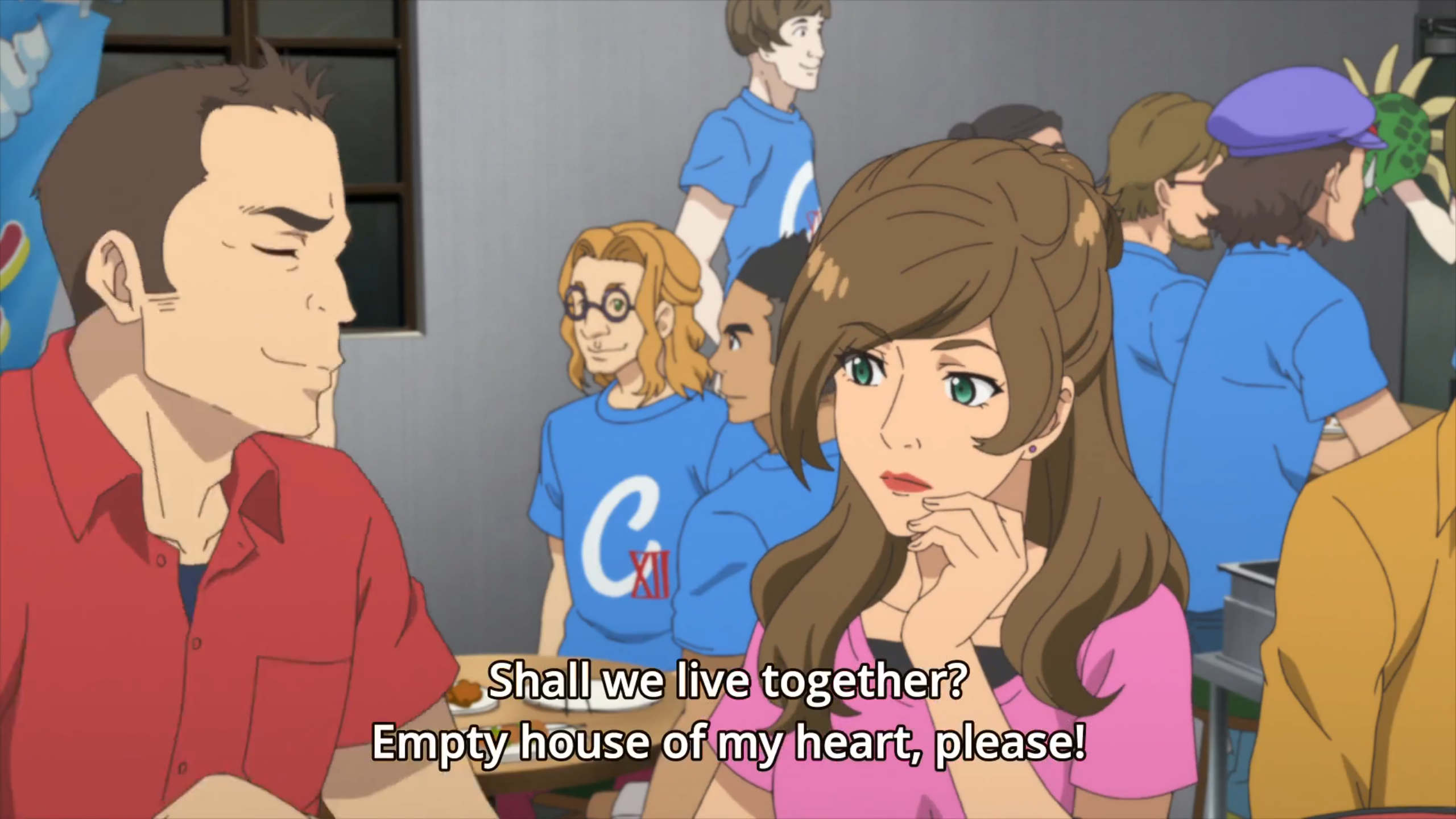
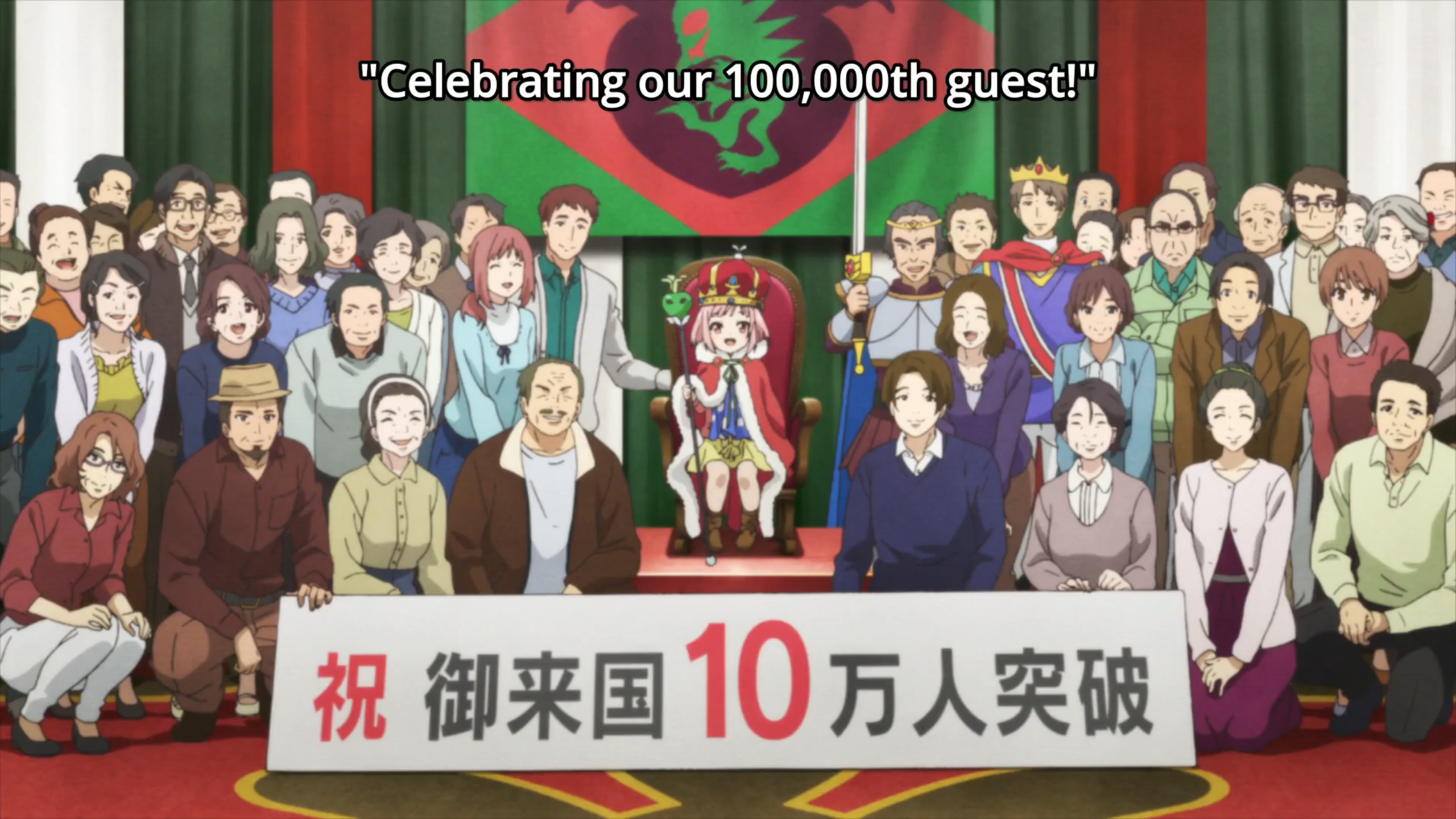
Yoshino Koharu takes a job as the Queen of Chupacabra kingdom. This is a made up kingdom for tourism that’s in the small town of Manoyama. For a year, she’s part of a government of ministers that try to revitalize the small town and bring back some of the culture it lost as time went on and the town shrunk. The story follows Yoshino alongside four other young women who all have their own reasons for working in Manoyama. Some grew up there and wanted to see it shine, others came to escape the big city or to come back home after the big city didn’t turn out to be what they wanted. These five women are now tasked with creating events, promoting them online, convincing the board of merchants and working hard for a year to make sure the town stays relevant.
No context need for this one I reckon.
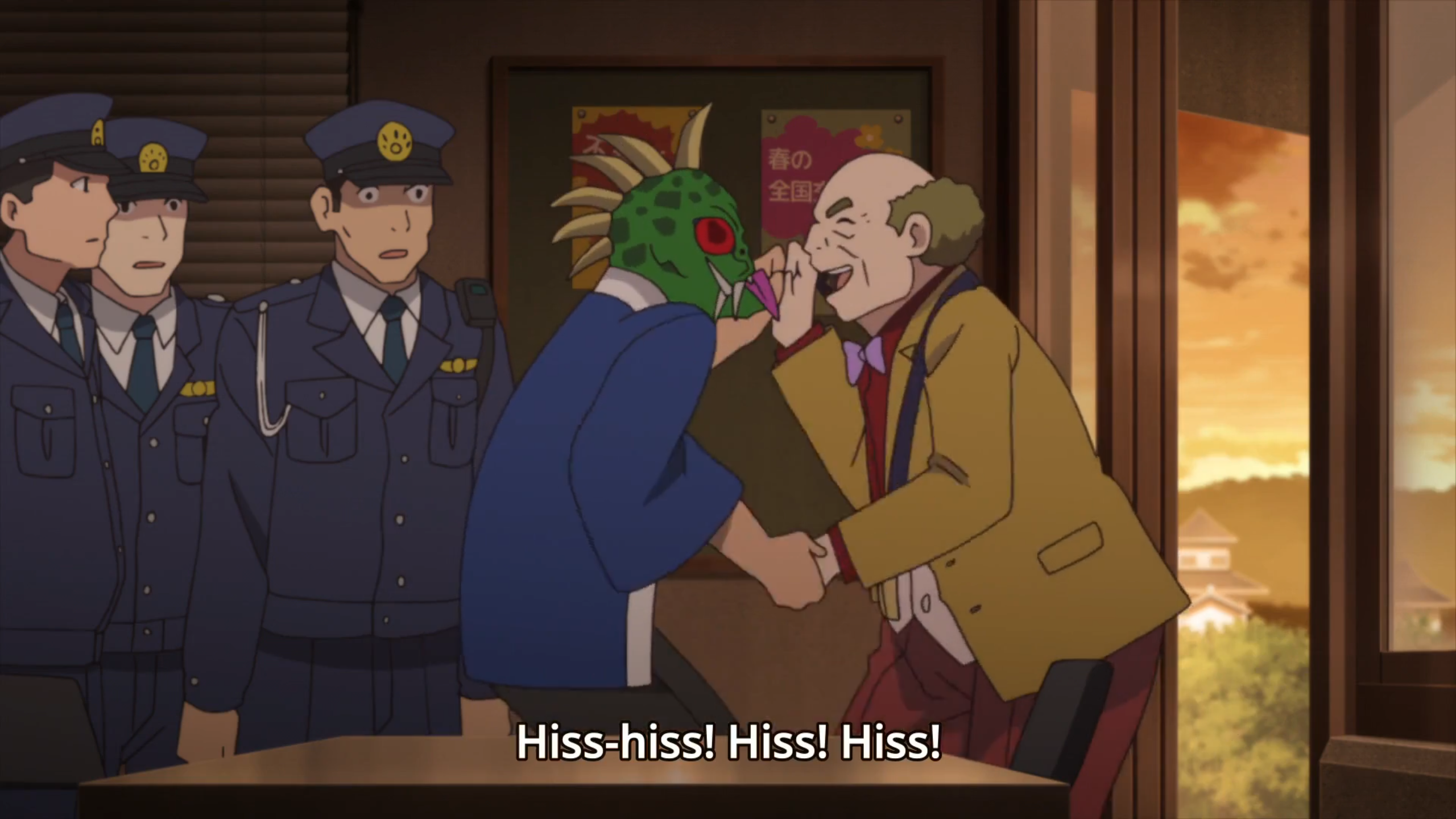
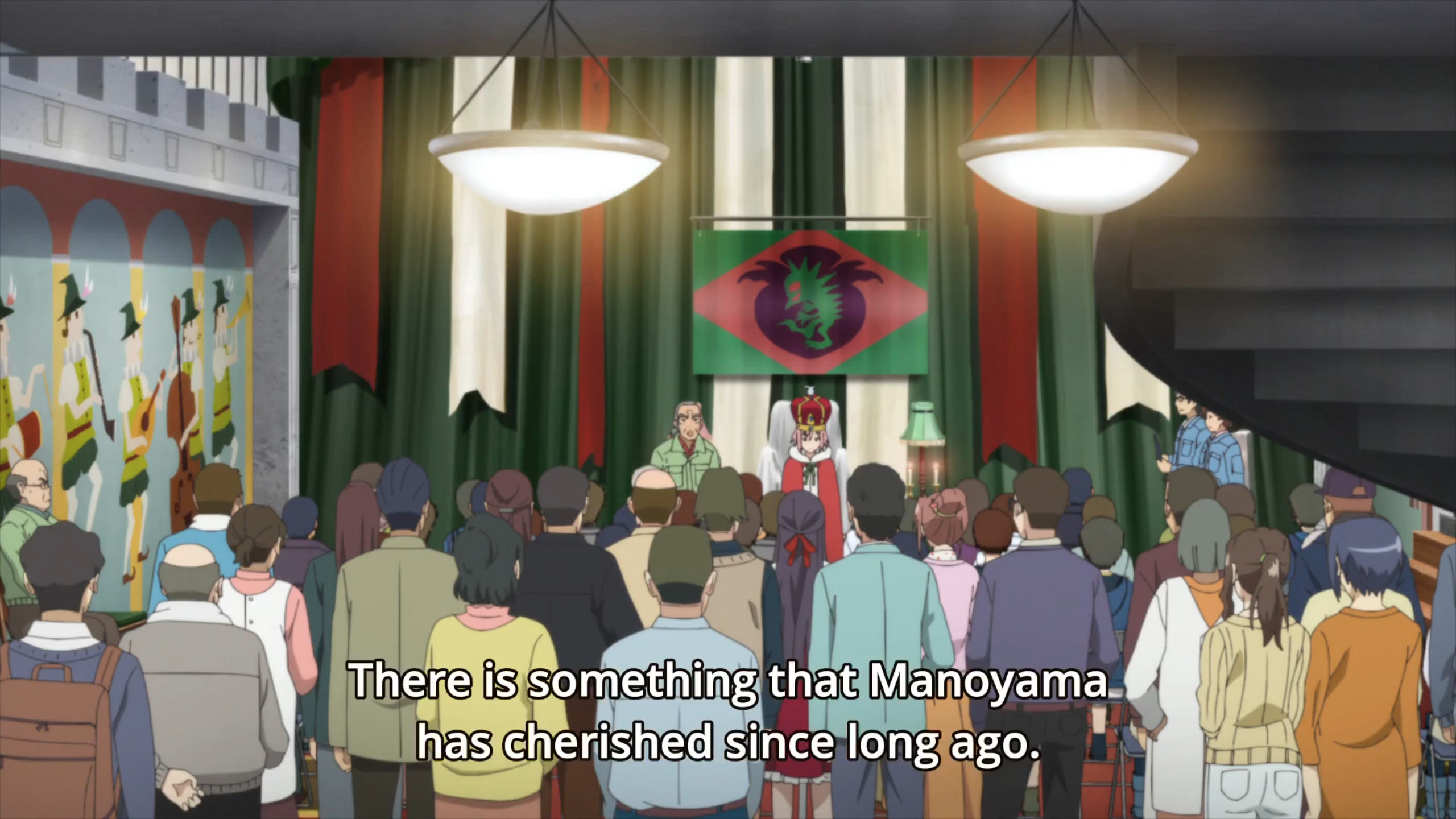
The first half of the show is a little bit slow as we take our time to get to know some of the characters. As the show picks up steam, we start to see more and more about what makes Manoyama interesting. Sure, it’s a small town like any other, but they have their own festivals, their own history and many of the older people living there still remember a time before things started getting quiet. We run into problems with a filming crew that doesn’t quite make the footage they wanted, the head of the merchants board and the chief of the cultural board are old friends who don’t like each other at all right now, there’s a professor of anthropology who’s studied the town for decades. My favorite little bit of information is that the people who live a bit further out from Manoyama all hang certain lanterns outside their house at night. If one of the houses is missing a lantern, that signals that something has gone wrong. It’s a very practical system in a place where technology feels alien and out of place. As we progress through the story we see more and more of these interesting cultural touchstones. The local police officer, book seller and bus driver once hid a dragon toy in the local playground. The daughter of the local restaurant wants to move to Tokyo, the bus line isn’t profitable, the old school is going to be bulldozed if they don’t find a use for it.
Tradition is what keeps us special. Just don’t consider it to be more important than progress.
All of this culminates in a festival where the entire town comes together after differences have been settled. Everyone celebrates the uniqueness that their village has and with the future secured thanks to the help of some kind outsiders things look like they’re going to be okay. Speaking of outsiders, a man named Sandal moved to the city and seems to be an all around oddball throughout the story. He’s an artist and a bit of a poet at times but he comes to be fully accepted by the Manoyama residents and ends up just as much a part of their village as anyone else. Also, his voice actor has one of the most pleasant voices I’ve ever heard. After everything is solved, we move on from the project. The year of being a queen is over and Yoshino and the others need to decide what they want to do next. I won’t spoil what she decides but I think the decision she ends up making was better than anything I could have predicted. Although it took me almost 7 years to finally finish this show, I think it’s a very good slice of anime that should get more recognition than it does. If you like shows like Yuru Camp, Non Non Biyori and Barakamon, this one will be perfect to watch next. Thanks for reading!
Paint those sights you want to remember for a long time.
A few weeks before Christmas I got very sick with covid. I had to spend the week and a half leading up to Christmas mostly cooped up in my room. Once the worst symptoms had gone away, I needed something to take my mind off of how bad I was feeling so I decided to read some manga. I first reread most of Jujutsu Kaisen before finally giving Chainsaw Man a shot. It was better than I expected, I’m kind of looking forward to the continuation of the anime now. After finishing those two I wasn’t quite sure what to read. Suddenly I got the urge to re-read The Promised Neverland. I remember really liking the manga even though a lot of people seemed to dislike the ending. After reading the entire manga I got a much worse idea. What if I finally sat down and watched the second half of season 2. I dropped it after five episodes because it skipped one of my favorite arcs in the manga but I figured if I were to review the series I should finish it. So now that I’ve read the manga again and watched the entire anime, let’s talk about both. As you might have guessed by now, this post will include major spoilers for the Promised Neverland manga and anime, so beware of that.
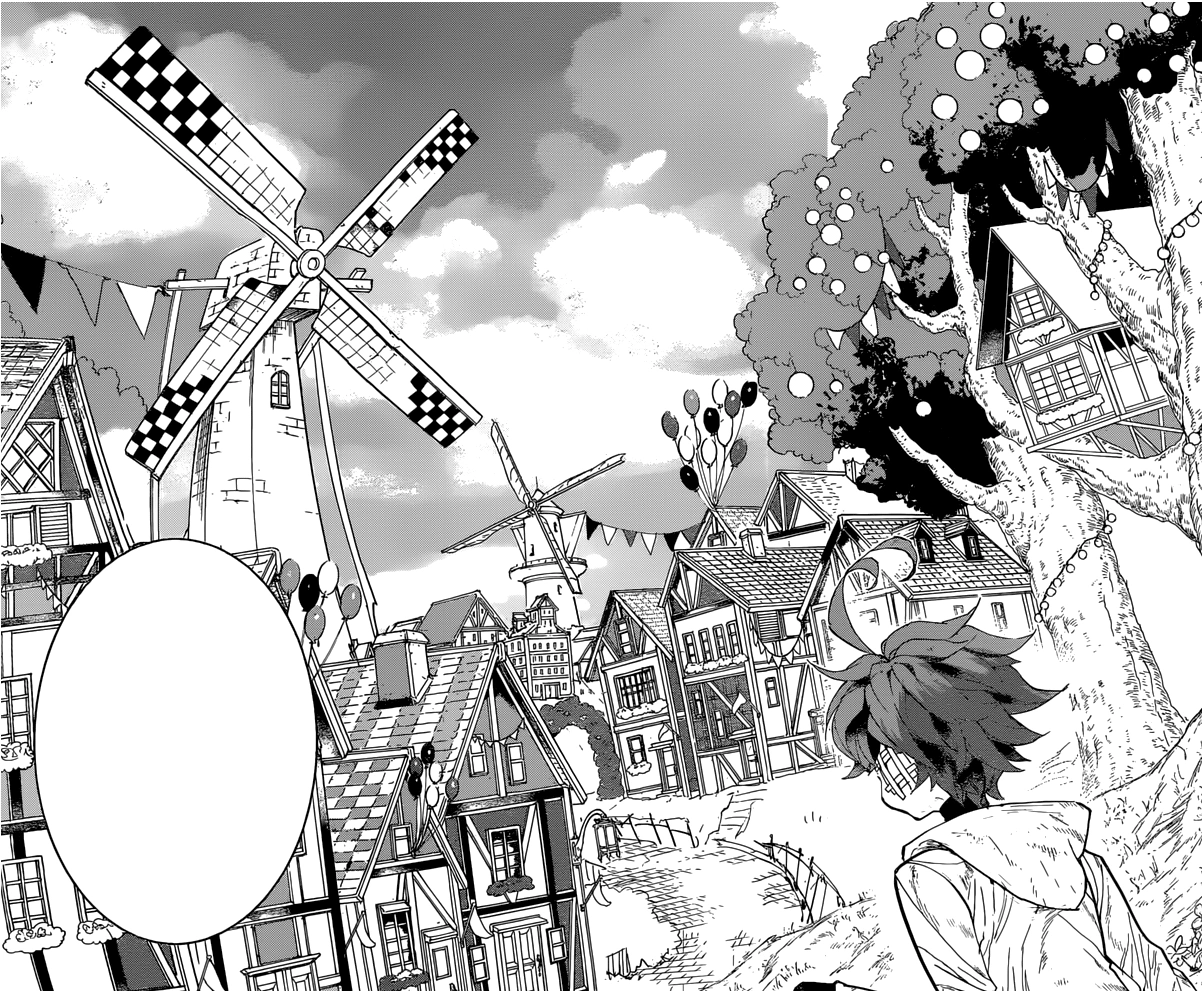
This is the moment where things really kick off, when Emma finds a seemingly abandoned village in the middle of a forest, instead of a clue to their escape.
First, let’s take a moment to talk about everything the manga did right in my opinion, to kind of get an idea for what I was expecting when the anime announced its second season. After escaping from Grace Field, the children managed to find a hideout that William Minerva prepared for them. There they found another escapee who is much older than them. It turns out he’s lived there for a while already and has slowly gone crazy. After that, Emma convinces him to bring her and Ray to Goldy Pond, where the next clue leads them. Goldy Pond was completely skipped in the anime, which is a shame. Goldy Pond is the name of a secret hunting ground where several noble demons hunt children for sport. Emma is whisked away to this place where she teams up with some of the surviving children there to fight back against the demons. We also learn that the crazy guy, whose name is Yugo, was part of a big group of escapees who found Goldy Pond and were subsequently all slaughtered.
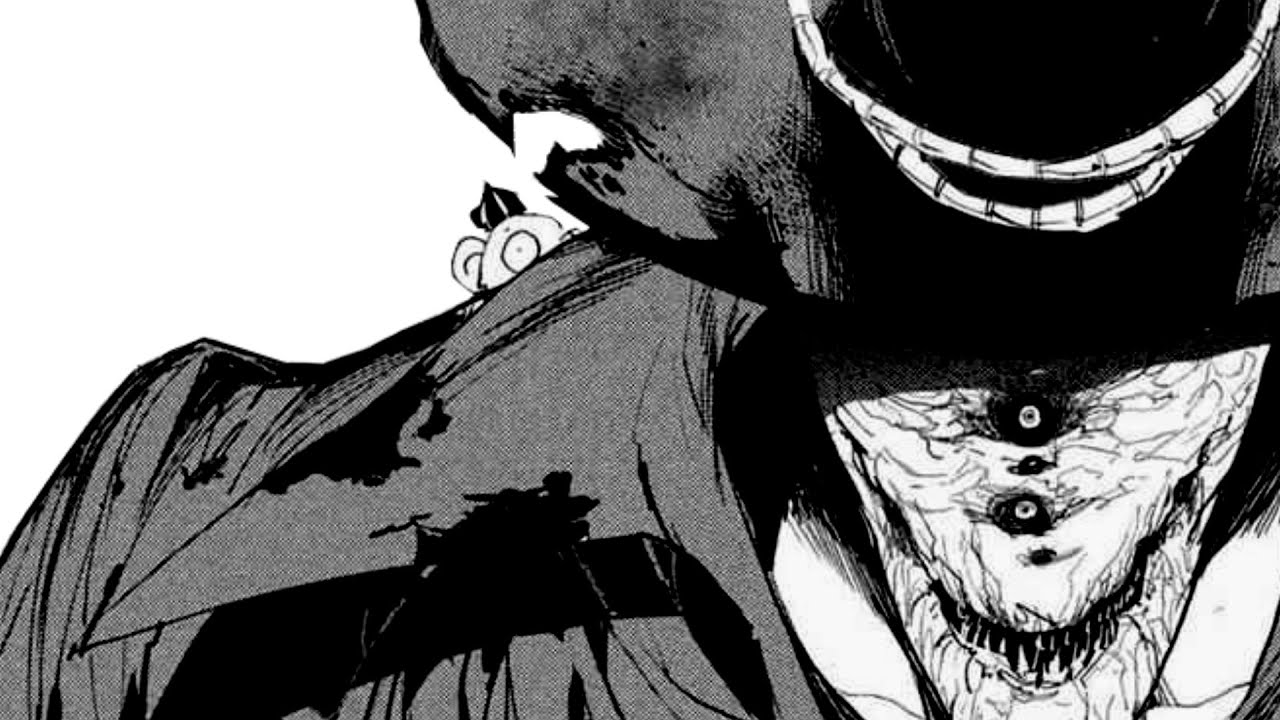
The terrifying villain known as Archduke Lewis.
Unbeknownst to Yugo, his good friend Lucas was still alive at Goldy Pond. After an intense battle between humans and demons, which culminates in the humans defeating Lewis, a very powerful demon, Lucas and Yugo team up and everyone goes back to the shelter to regroup. During their time at the shelter, Peter Ratri sends a squad of soldiers to kill the escapees, which turns into a bloodbath during which a few of the young children as well as Yugo and Lucas unfortunately die. The gang then goes on a journey to reforge the promise with a demon deity so that humans and demons can live freely.
After encountering this deity once and figuring out many clues to their current predicament, the children encounter Jin and Hayato. They are other escapees and they’re working directly for William Minerva. This can’t be, since Minerva is supposed to be dead, but the children go with them anyway, after retrieving some medicine from a nearby plant. When they get to the village, they find out that their friend Norman is still alive, and he’s grown considerably. We finally learn what happened to Adam, who is a strong child that was with the Goldy Pond group. The reason he kept saying Norman’s number is because they were both at the Lambda research facility, where Peter Ratri is trying to create the ultimate cattle. Norman and the other Lambda escapees want to kill all the demons but Emma and Ray want to save the demons as well, recognizing that there isn’t really a racial divide, there’s a socio-economic divide that’s being sold as a racial divide. Or I’m looking into things too much, don’t mind me. Either way, Emma’s plan is to use Musica’s blood to help the demons become immune to the degeneration that happens when they stop eating humans and then reforging the promise with their deity so all children are allowed to be free.
Aishe and the demon that raised her. They’re a happy family, despite their difference.
To make sure it’s clear that demons come in all shapes and sizes we meet Aishe. She doesn’t speak human language but is loyal to Norman. She, as well as some others, are sent by Norman to kill Musica instead of helping the kids. As they kids travel, they learn that Aishe isn’t actually loyal to Norman, but instead is angry that they killed the demon that cared for her. Her demon was kind and raised her well, and she harbors anger about his death. With some trickery and help, they manage to overwhelm the attackers and reunite with Musica and Sonju. At this point we get to the end of the story and if you’ve read it, I won’t summarize all of it since we’ll be here all day. But to make a long story short, the demons are saved while the nobility is slaughtered with the help of an exiled clan. The populace is given the special blood that Musica has and Sonju turned out to be the brother of the former queen, who is killed by our heroes. They find a strange ally in Lewis, who managed to survive the fight at Goldy Pond due to having a second core, and the promise is reforged, leading to the children and their (farm) mothers being allowed to leave to the human world. Isabella and Peter Ratri die in the process and the system is overturned completely, separating the demon and the human world for good.
This reunion feels completely undeserved and meaningless. Norman hasn’t changed at all, and his later desperation to be violent feels much more out of character.
This brings me to the unfortunate reality that is the second season of The Promised Neverland Anime. In the anime we skip all of Goldy Pond as well as meeting those escapee children and Yugo and Lucas. Instead we go from the escape almost immediately to reuniting with Norman. Norman’s gone through the same process as in the manga, except on a much smaller scale. He’s just a guy with a few escapees here, not the leader of a massive group of refugees. Jin, Hayato and Aishe are completely absent from the story and instead of trying to kill Musica, Norman straight up lies to his friends purely to get vengeance. A lot of Norman’s goals are the same as in the manga, but without any of the buildup you get when reading the much longer story. The nobles are completely forgotten except for a small mention towards the end, making it seem like there was no real power structure in the demon world, but it was just Peter Ratri farming kids for clout. The promise is forgone as well, making the entire system hinge on pure trust on equal sides, which would never work when you look at the nature of some of the demons. A lot of the anime’s ending ends up not being very sensible. It wants to conclude the story in the same way as in the manga, but we go from narrowly escaping one woman and a farm to torching half the demon army in the span of three episodes. Emma’s naive character is also turned up to 11 and although she’s not a particularly realistic character to begin with, the manga makes sure to properly build her up, making her consistent within the logic set for her character. In the anime she just kind of doesn’t want to kill all demons. The farms mainly get liberated offscreen in what is a throwaway after credits scene and we’re left feeling hollow about what we just watched.
Because the season lacks any clear direction and plan, they kept in the fact that Emma had to make a sacrifice for their freedom, but instead of the already shaky one they had in the manga, she just kind of goes offscreen and fixes the entire problem with the demons. It feels unrewarding and kind of lame.
I know many manga readers had umbridge with the ending of the story and I can’t say I absolutely loved every choice the author made. I do commend the author for making a very interesting story that stayed consistent throughout and although it took some suspense of disbelief, I quite liked how everything got resolved nicely, but not without strife. In the anime there are no stakes. Everyone survived, no one got hurt, they defeated the entire demon world in a few days without any sacrifices. How big of a threat were these guys really? The storytelling in the anime doesn’t respect the viewers intelligence and that’s a real shame. This could have been a great anime, running for an extra two or three cours and properly developing its characters. It had a lot to say about society, consumption and reaching across the aisle to those who seem like strangers. Instead it abandons all of that for a terribly rushed season of anime with no stakes, no logic and quite frankly nothing really going for it. I would recommend the manga for anyone who watched the anime and felt disappointed. Even with the spoilers in this review, I still think it’s worth reading it to see for yourself. But that’s me and my opinion. Of course anyone creating an anime is trying to write the best story they can, and sometimes you don’t reach your goals. I wouldn’t want anyone to feel bad about it, but I do want to put into words what I didn’t like about it. Thanks for reading.
How was I not going to talk about this today? With the start of a brand new year and a brand new arc in the One Piece anime, Toei Animation delivered some amazing theme songs. Especially the new opening song is out of this world. Because it goes so heavily into the upcoming arc and shows a lot of interesting moments from it, this post will contain spoilers for the One Piece manga. If you’re not up to date on the manga, do not read this post. Before we dive into the opening, let’s talk about the ending first.
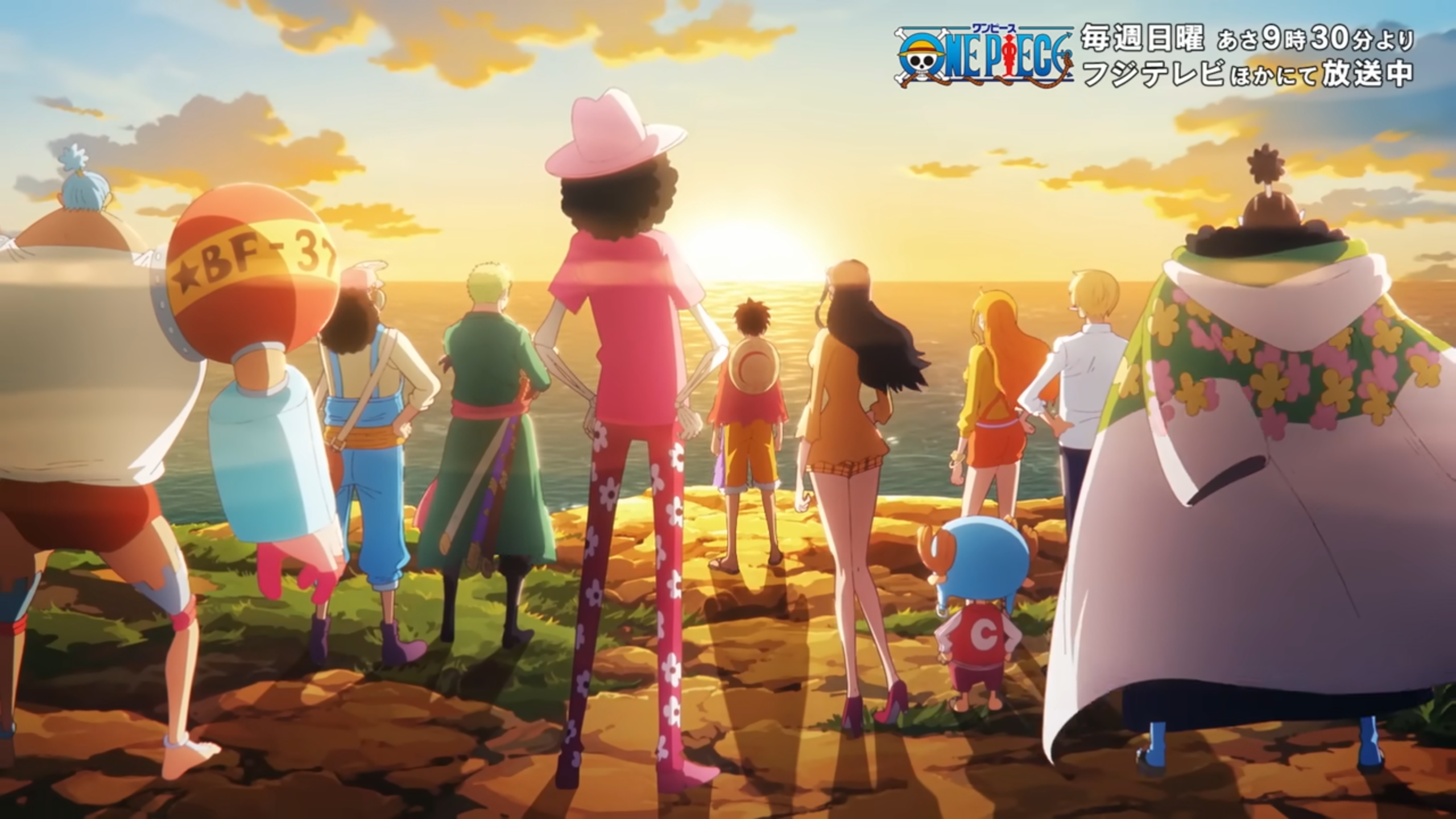
This shot from the ending is gorgeously drawn, the colors are really popping.
The 20th ending theme for One Piece is ‘Dear Sunrise’ by Otsuki Maki. It’s a pleasant song that reminds me of some of the early ending themes. It gives off similar vibes to the very first opening even in how calming it is. We get a nice collection of recaps of how each of the Straw Hats ended up joining the crew before cutting to the ship sailing off into the endless ocean. The art is pretty and the animation is fluid. Compared to the opening there’s not all that much here when it comes to visuals but the first shot of Luffy standing and staring out at the ocean while the crew slowly pops into frame one by one is a nice callback to the first ending. But this ending, pleasant as it is, does not compare to the absolute insanity that is the opening. The 25th opening may have been called ‘The Peak’ but opening 26 shows us that there are still higher heights to get to.
Right before this shot we get a view of the Merry, before it transforms into the Sunny. What an amazing transition.
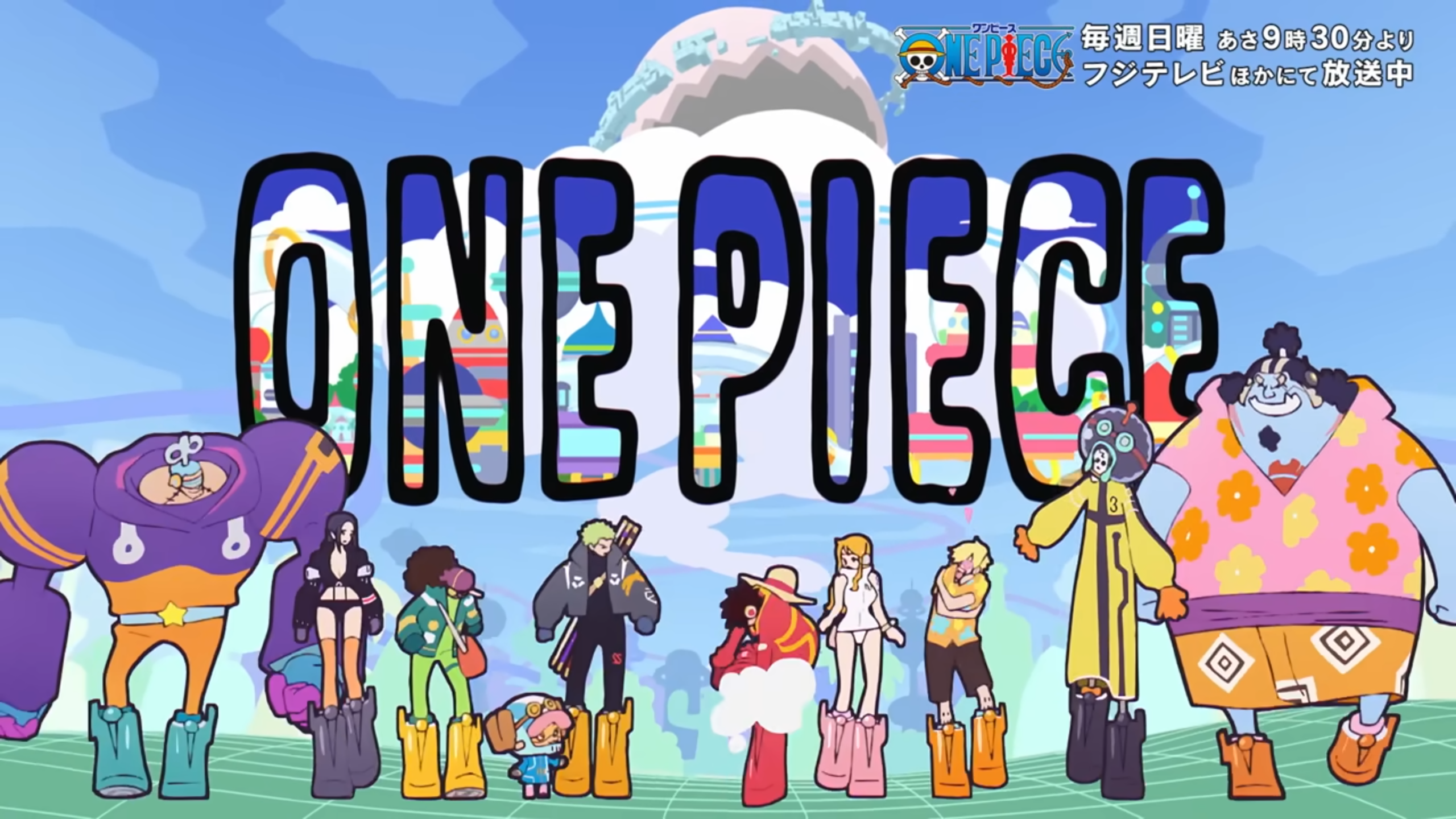
Where do I even begin? I think I’m just going to go through the opening entirely and talk about each cool moment it shows off. Spoilers ahead of course. We start off relatively simple. We see the ship from above the clouds before zooming in at Luffy laying on the deck. If you pay close attention you can see that this is from the manga chapter where Luffy talks about his dream, except animated and drawn in an incredible style. We then move on to the first shot of the crew in their Egghead outfits as they’re wal;king in front of the words One Piece that show off the buildings on egghead. The cool boots steal the show here and Jinbe is looking so fly.
Would you look at them, so stylish.
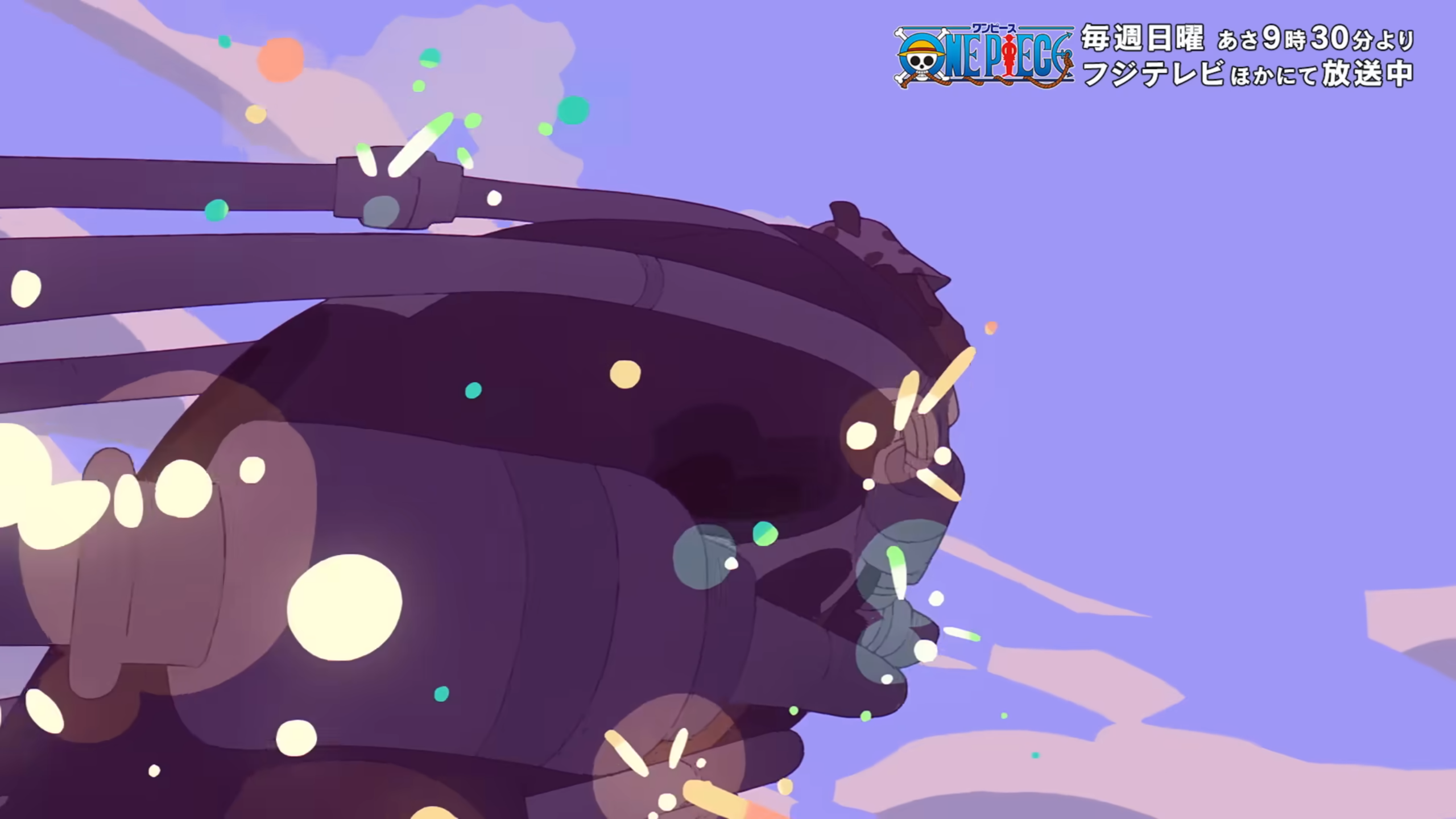
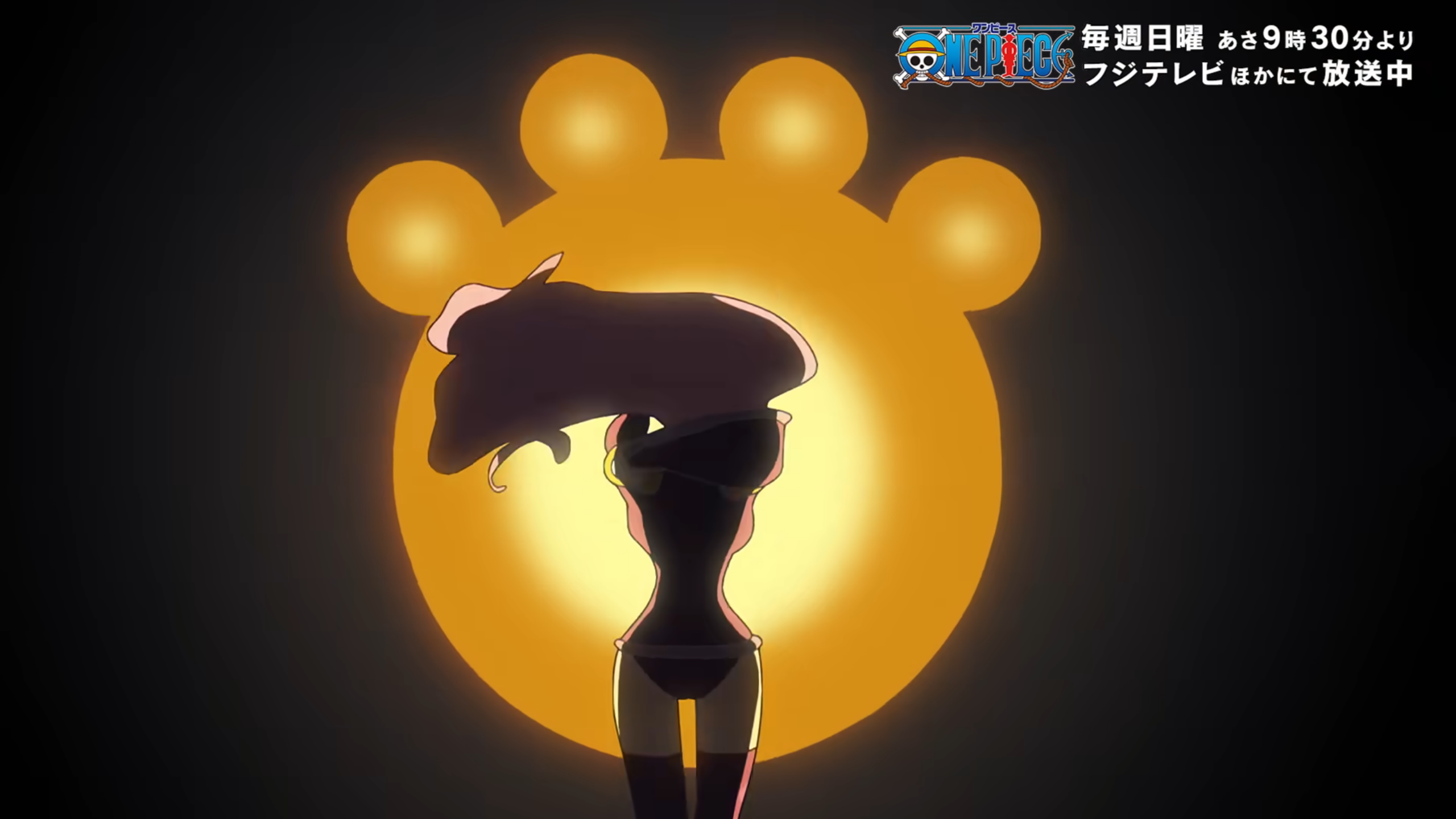
We then get a few shots which include the ship being carried by a giant robot, a shot of all the different Punk’s as well as Lucci, Kaku and Stussy hiding in the background of the shot behind their masks. This is such a well done shot that the first few times I watched the opening I didn’t even realize what was there, I just saw the masks. We switch to Zoro and Luffy goofing off as a monitor behind them reveals many of the characters we see this arc at a rapid pace. Besides the punks we see Kizaru, the members of Sword and Garp, Buggy and his new company. We see the Heart Pirates drowning in their submarine followed by a quick rotating shot of the Sword members that will go in to save Coby later this arc. Speaking of Coby, we see him running away with the ball and chain in his hands. We flash cut to Sentomaru and then to Kizaru which turns into a beautiful shot of Kuma ripping free from the mechanical bindings that bind him to the world government, a final act of defiance against the people that took so much from him and never held up their end of the bargain. This opening is very well done guys, I mean it.
Kuma is the absolute goat of One Piece, No doubt about it.This is what I mean, they have winter outfits for Punk Hazard and their Dressrosa/Zou outfits when they move forward.
Amongst showing baby Sentomaru and one of the Punks we get our first shot of Bonney, trying to keep her head above the water. We then move to my favorite part of the entire opening. The crew is walking along different backgrounds, showing off the outfits they were wearing in those specific arcs. As they transition from one background to the other, their outfits change with them. Such a gorgeous sequence I’ve watched it on repeat numerous times. We then see a gorgeous clash between Luffy and Rob Lucci with gears flying through the screen, obviously referring to Luffy’s different powers. This makes me wonder if the side effects of using the gears that shorten his life are still a thing now that he’s awakened as Nika? Who knows.
Having just read the latest chapter, this shot is extra sad to watch.
We move on to the different clashes that will take place in the near future. First we see Kid versus Shanks, then Law versus Blackbeard. Kuzan and Garp clash in the aftermath of Coby’s jailbreak. Zoro fights the Mihawk pacifista and Luffy, of course, fights with Rob Lucci once more.
A shot of Morgan and Wapol is followed by a sad shot, presumably referring to King Cobra’s death. We move to the throne room with the swords of the twenty kings and Imu in the background, sitting menacingly on the throne. Sabo, Kid, Law and Coby all stumble through the frame, each going through their own serious battles. We very quickly transition into Vivi moving through the hole in the wall, signaling her escape from CP0 and then move onto Bonney stepping into Kuma’s memories to finish off the rapid sequence. We then get a shot of Egghead from overhead on a map and then the route along the grand line shows up. We see the crew one last time before we end the opening.
The infamous warlord of the sea and his crew.
This opening is animated by the now legendary Megumi Ishitani. Anything she touches turns into pure art. And everyone else who worked on this did a stellar job too. I haven’t been this excited for the anime part of One Piece since the first Wano opening was released, showing an incredible uptick in quality. One Piece fans are eating good in 2024. Thank you so much for reading this, I have listened to the opening song way too much already!